Molecular Hydrogen and Cancer Research (Colon, Cervical, Tongue Cancer): What the Science Really Says
May 14, 2026 2026-05-14 5:19Molecular Hydrogen and Cancer Research (Colon, Cervical, Tongue Cancer): What the Science Really Says
Molecular Hydrogen and Cancer Research (Colon, Cervical, Tongue Cancer): What the Science Really Says
Written by Clinical Researcher, Dr. Aamir Sohail, PhD in Biochemistry and Molecular Biology: aamir.sohail@oncofit.in
Many people searching for hydrogen inhalation machines or hydrogen water products ask the same important question: what does molecular hydrogen and cancer research actually show? This is a sensitive topic because early studies are interesting, but they do not prove that hydrogen inhalation or hydrogen water cures cancer. A careful reading shows that molecular hydrogen is mainly being studied for oxidative stress, inflammation, cell signaling, chemotherapy-related side effects, and possible anti-tumor mechanisms in laboratory and animal models.
https://pubmed.ncbi.nlm.nih.gov/25870767/
https://pubmed.ncbi.nlm.nih.gov/35528164/
https://www.spandidos-publications.com/10.3892/mco.2017.1409/abstract
Health and Hydrogen provides PEM-based hydrogen inhalation machines and hydrogen water products for wellness, education, and research-informed use. For anyone with cancer or another serious medical condition, hydrogen products should be discussed with a qualified healthcare professional and should not replace oncology care, chemotherapy, radiation, surgery, medication, or medical follow-up.
https://healthandhydrogen.com/
Table of Contents
ToggleQuick Answer
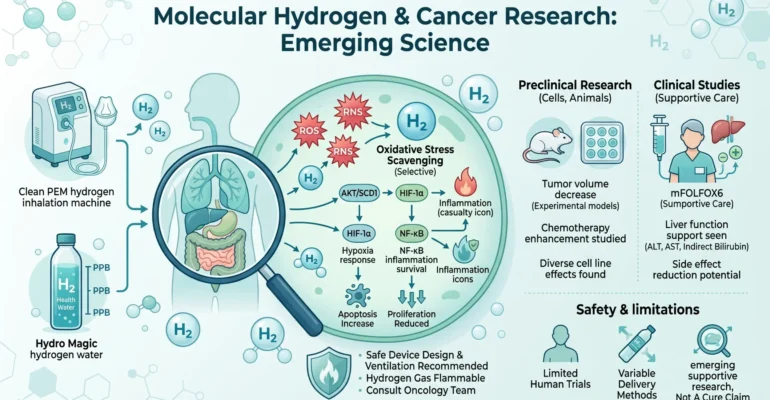
Molecular hydrogen and cancer research is promising but still early. Studies suggest hydrogen-rich water or hydrogen gas may influence oxidative stress, apoptosis, liver function during chemotherapy, and pathways such as AKT/SCD1, HIF-1α, and NF-κB. However, much of the evidence comes from cell, animal, or limited clinical studies. Hydrogen products should be viewed as wellness or supportive tools, not cancer treatments.
Key Takeaways
- Molecular hydrogen is being studied for oxidative stress, inflammation, and cellular signaling.
- Colorectal cancer studies are among the most relevant sources for this topic.
- A human colorectal cancer chemotherapy study focused on liver function, not tumor cure.
- Cervical cancer research found effects in HeLa cells and mouse models, not confirmed clinical treatment.
- Esophagus and tongue carcinoma evidence was cell-culture based and involved hydrogen-bubbled platinum-colloid.
- Safety matters because hydrogen gas is biologically low-toxicity but flammable at certain concentrations.
- Users with cancer should speak with their doctor before using hydrogen inhalation or hydrogen water products.
What Is Molecular Hydrogen?
Molecular hydrogen, written as H₂, is the smallest gas molecule. Because it is very small and non-polar, researchers study whether it can diffuse into tissues and influence oxidative stress, inflammation, mitochondrial responses, and cell signaling. This is why molecular hydrogen appears in research on many conditions, including cancer biology, liver function, neurological injury, and metabolic stress.
https://www.mdpi.com/1422-0067/23/5/2888
https://molecularhydrogeninstitute.org/is-molecular-hydrogen-safe/
For consumers, molecular hydrogen is usually delivered in two main ways: hydrogen-rich water and hydrogen gas inhalation. Hydrogen-rich water is water containing dissolved H₂. Hydrogen inhalation machines generate hydrogen gas, often using water electrolysis and PEM or SPE technology. Health and Hydrogen states that its devices use PEM technology and are designed for hydrogen inhalation in home, clinic, or wellness settings.
https://healthandhydrogen.com/
Why Is Molecular Hydrogen Being Studied in Cancer?
Cancer biology often involves oxidative stress, inflammation, mitochondrial changes, abnormal metabolism, immune changes, and disrupted cell-death signaling. Hydrogen research is interesting because H₂ may influence some of these systems. However, the word “may” is important. A laboratory result does not automatically become a human treatment. A mouse study does not automatically apply to a person. A supportive-care study during chemotherapy does not prove anti-cancer activity.
https://pubmed.ncbi.nlm.nih.gov/25870767/
https://pubmed.ncbi.nlm.nih.gov/35528164/
This balanced view is especially important for ecommerce websites. A hydrogen inhalation machine or hydrogen water bottle can be presented as a wellness product supported by emerging science, but it should not be marketed as a cure, treatment, prevention, or replacement for medical care. This is better for customer trust, medical safety, and long-term brand credibility.
What Does the Colon Cancer Hydrogen Water Study Show?
One important study, published in PeerJ in 2015, tested hydrogen water with 5-fluorouracil, also called 5-FU, in colon 26 cancer cells and a mouse model. The authors reported that hydrogen water improved survival in mice with colon 26-induced cancer, enhanced apoptosis in cancer cells, and increased markers linked with apoptosis, including p-AMPK, AIF, and caspase 3. They also reported that hydrogen water increased the inhibitory effect of 5-FU in the model.
https://pubmed.ncbi.nlm.nih.gov/25870767/
The study is important because it connects hydrogen water with a standard chemotherapy drug in a controlled experimental setting. However, it was not a human clinical trial. The results came from colon 26 cells and mice, so the findings should be described as preclinical evidence. It is also worth noting that the PubMed page lists a conflict-of-interest statement explaining that VanaH Co., Ltd supplied the hydrogen water and supported the experimental project.
https://pubmed.ncbi.nlm.nih.gov/25870767/
The practical meaning is simple: this study supports further research into hydrogen water and chemotherapy-related cancer biology, but it does not prove that drinking hydrogen water treats colon cancer in humans. For Health and Hydrogen readers, the safer message is that hydrogen water is being scientifically investigated and should be used responsibly, especially by people under active medical treatment.
What Does the 2022 Colorectal Cancer AKT/SCD1 Study Show?
A 2022 study looked at molecular hydrogen and colorectal cancer through the AKT/SCD1 signaling pathway. The researchers tested colorectal cancer cell lines including RKO, SW480, and HCT116, and they also used xenograft mouse models. In the animal model, mice inhaled 67% hydrogen for two hours per day. The study reported that hydrogen suppressed colorectal cancer cell proliferation, reduced tumor volume and weight in vivo, and appeared to act through reduced pAKT/SCD1 signaling.
https://pubmed.ncbi.nlm.nih.gov/35528164/
This is one of the stronger mechanistic papers in the set because it does not only report that hydrogen had an effect. It also proposes a pathway. AKT is involved in growth and survival signaling, while SCD1 is connected with lipid metabolism and has been studied in cancer progression. The authors also reported that SCD1 expression was higher in colorectal cancer tissues than in normal epithelial tissues and was associated with more advanced disease characteristics.
https://pubmed.ncbi.nlm.nih.gov/35528164/
Still, this study should not be overused in marketing. The inhaled concentration used in the mouse model was high, and the research was not a consumer-device clinical trial. It supports the idea that molecular hydrogen may influence cancer-related signaling pathways, but it does not prove that a hydrogen inhalation machine can treat colorectal cancer in people.
What Does Hydrogen-Rich Water Show During Colorectal Cancer Chemotherapy?
A 2017 clinical study examined hydrogen-rich water in colorectal cancer patients receiving mFOLFOX6 chemotherapy. This is especially relevant because it included human patients. The study was controlled, randomized, and single-blind. A total of 152 patients were recruited, 144 were randomized, and 136 patients were included in the final analysis. The researchers looked at liver function markers such as ALT, AST, alkaline phosphatase, indirect bilirubin, and direct bilirubin.
https://www.spandidos-publications.com/10.3892/mco.2017.1409/abstract
The key finding was not that hydrogen-rich water treated colorectal cancer. The main finding was that the placebo group showed increases in ALT, AST, and indirect bilirubin after chemotherapy, while the hydrogen-rich water group did not show significant liver function changes before and after treatment. The authors concluded that hydrogen-rich water appeared to alleviate mFOLFOX6-related liver injury.
https://www.spandidos-publications.com/10.3892/mco.2017.1409/abstract
For readers, this is an important distinction. The study is better understood as supportive-care research around chemotherapy-related liver stress, not as proof of anti-cancer treatment. People receiving chemotherapy should never add any wellness product without discussing it with their oncology team because timing, medication interactions, hydration status, and liver function monitoring matter.
What Does Hydrogen Research Show in Cervical Cancer?
A 2021 study investigated hydrogen inhalation in cervical cancer models using HeLa cervical cancer cells, HaCaT keratinocytes, and a HeLa xenograft mouse model. The researchers used tests for apoptosis, proliferation, oxidative stress, tumor growth, and gene expression. They reported increased apoptosis, reduced cell proliferation, and reduced oxidative stress in hydrogen-treated HeLa cells, while HaCaT cells were not affected in the same way.
https://pubmed.ncbi.nlm.nih.gov/34080660/
The study also used high-throughput RNA sequencing and found that changes in HIF-1α and NF-κB p65 signaling were associated with the observed anti-tumor effects. These pathways are important because HIF-1α is linked with hypoxia response and tumor adaptation, while NF-κB is linked with inflammation, survival signaling, and cancer biology.
https://pubmed.ncbi.nlm.nih.gov/34080660/
This paper is useful for explaining possible mechanisms, but it remains preclinical. It does not prove that hydrogen inhalation treats cervical cancer in humans. The best way to discuss it is to say that hydrogen inhalation has shown tumor-suppressive effects in specific cervical cancer experimental models and deserves further clinical study.
What About Esophagus and Tongue Carcinoma Research?
The fifth article provided focused on hydrogen-bubbled platinum-colloid and human esophagus or tongue carcinoma cells. The title itself is important because this was not simply ordinary hydrogen water or standard hydrogen gas inhalation. It involved hydrogen nano-bubbles and platinum-povidone colloid in a cell-culture setting. Search-indexed summaries describe suppression of human esophagus-derived carcinoma cells and tongue-derived carcinoma cells, with attention to intracellular platinum uptake and reduced normal-cell mortality.
https://pubmed.ncbi.nlm.nih.gov/32710259/
This type of research is scientifically interesting, but it should be interpreted very cautiously for consumers. A hydrogen-bubbled platinum-colloid cell-culture experiment is not the same as using a hydrogen inhalation machine or hydrogen water bottle at home. For SEO and trust, this study can be included as part of the broader hydrogen and cancer-research landscape, but it should not be used to imply a direct product benefit.
https://pubmed.ncbi.nlm.nih.gov/32710259/
What Are the Limitations of Molecular Hydrogen and Cancer Research?
The biggest limitation is that much of the evidence is preclinical. Cell studies are useful for exploring mechanisms, but cancer cells in a dish do not represent the full human body. Mouse models help scientists test biological effects, but they cannot fully reproduce human cancer, immune function, tumor diversity, medication history, or clinical outcomes.
Another limitation is delivery method. The studies include hydrogen-rich water, hydrogen gas inhalation, and hydrogen-bubbled platinum-colloid. These are not interchangeable. A finding from hydrogen-rich water cannot automatically be applied to inhalation, and a finding from high-concentration hydrogen gas in animals cannot automatically be applied to a consumer PEM hydrogen machine.
A third limitation is that hydrogen may not act the same way in every cancer model. One 2022 study found that molecular hydrogen enhanced proliferation in four of seven tested human cancer cell lines under certain experimental conditions, and the authors connected this response with mitochondrial unfolded protein response and high mitochondrial electron transport chain activity. This does not cancel the positive studies, but it shows why careful, cancer-specific, clinically supervised research is necessary.
https://www.mdpi.com/1422-0067/23/5/2888
This is why Health and Hydrogen content should avoid exaggerated phrases such as “hydrogen kills cancer” or “hydrogen cures tumors.” A more accurate statement is that molecular hydrogen is being investigated for cancer-related oxidative stress, liver-function support during chemotherapy, and experimental anti-tumor mechanisms.
Hydrogen Water vs Hydrogen Inhalation Machines
Hydrogen-rich water and hydrogen inhalation are different product categories. Hydrogen water delivers dissolved H₂ through drinking water. Hydrogen inhalation delivers H₂ gas through a nasal cannula or breathing accessory, depending on the machine and setup. The cancer-related studies provided include both hydrogen water and inhalation, so the article should not treat them as identical.
Health and Hydrogen offers several hydrogen inhalation machines and a hydrogen water bottle. The HAH 3000 product page lists three adjustable flow settings with total flow at 3000, 2000, or 1000 ml/min, with hydrogen output listed at 2000, 1333, or 667 ml/min, and oxygen output listed at 1000, 667, or 333 ml/min. The page also lists 99.99% hydrogen purity and distilled water requirements.
https://healthandhydrogen.com/hah-3000/
For users wanting a smaller model, the HAH 1800 page lists adjustable flow rates of 900, 1200, and 1800 ml/min and SPE and PEM technology. The HAH 900 page lists 900 ml total output with 600 ml/min H₂ and 300 ml/min O₂. The HAH 450 page lists 450 ml total output with 300 ml/min H₂ and 150 ml/min O₂.
https://healthandhydrogen.com/hah-1800/
https://healthandhydrogen.com/hah-900/
https://healthandhydrogen.com/hah-450/
For hydrogen water users, the Hydro Magic Intelligent Hydrogen Water Bottle page lists a 280 to 350 mL bottle capacity, 2000 to 9000 PPB hydrogen level, Type-C charging, platinum titanium electrode material, and Tritan plastic body material. Product-specific claims should stay limited to what the product page states.
https://healthandhydrogen.com/hah-hm350/
How Should a Buyer Choose a Hydrogen Product?
A buyer should begin with the use case. For occasional personal wellness use, lower-output machines or a hydrogen water bottle may be enough. For more frequent use, shared clinic use, or users who specifically want higher inhalation output, a higher-flow machine may be more suitable. Health and Hydrogen’s FAQ page states that it offers output levels including 3 liters, 1.8 liters, 1 liter, 900 ml, and 450 ml, and suggests that choice depends on intended use, frequency, and whether more than one person will use the machine.
https://healthandhydrogen.com/faqs/
A buyer should also consider support, accessories, setup education, and maintenance. Health and Hydrogen provides product pages, accessories, FAQs, contact options, and supporting videos for getting started, cleaning, replacing water, and testing output. These resources matter because correct setup and maintenance are part of responsible hydrogen use.
https://healthandhydrogen.com/video-session/
https://healthandhydrogen.com/accessories-for-hydrogen-inhalation-machines/
https://healthandhydrogen.com/support/
https://healthandhydrogen.com/contact/
Is Hydrogen Inhalation Safe?
Hydrogen has a low biological toxicity profile, but gas safety still matters. The Molecular Hydrogen Institute explains that hydrogen is generally considered safe across multiple delivery methods, but also notes that hydrogen gas is highly flammable between 4% and 75% by volume and that inhalation equipment should be chosen carefully to minimize risk.
https://molecularhydrogeninstitute.org/is-molecular-hydrogen-safe/
A safety study in healthy adults reported that inhalation of 2.4% hydrogen gas did not appear to cause clinically significant adverse effects, although the authors also stated that future studies need to be powered to further evaluate safety. This is reassuring, but it does not mean every device, setting, concentration, or medical situation is automatically safe.
https://pubmed.ncbi.nlm.nih.gov/34651133/
Practical safety steps include reading the product manual, using the correct water type, avoiding open flames or smoking near the machine, ensuring suitable ventilation, keeping the machine clean, using correct accessories, and contacting support if anything seems unusual. The Health and Hydrogen HAH 3000 water-filling guide also warns not to overfill the water tank and explains the need to follow the marked maximum level.
https://healthandhydrogen.com/proper-water-filling-for-the-hah-3000/
Can Hydrogen Products Be Used During Cancer Care?
People undergoing cancer care should ask their oncologist before using hydrogen inhalation or hydrogen water. This is not because hydrogen is automatically dangerous, but because cancer care is complex. A doctor may need to consider chemotherapy schedule, liver function, oxygen needs, surgery timing, radiation treatment, medications, immune status, and overall health.
The most responsible position is to view molecular hydrogen as an emerging supportive research area, not an approved cancer treatment. The colorectal chemotherapy study suggests possible liver-function support during mFOLFOX6, but even that finding should be discussed with a clinician before use.
https://www.spandidos-publications.com/10.3892/mco.2017.1409/abstract
FAQs About Molecular Hydrogen and Cancer Research
1. Does molecular hydrogen cure cancer?
No. Current evidence does not prove that molecular hydrogen cures cancer. Some studies show interesting effects in cells, animals, or supportive-care settings, but these findings should not be treated as proof of cure.
https://pubmed.ncbi.nlm.nih.gov/25870767/
https://pubmed.ncbi.nlm.nih.gov/35528164/
2. What is the strongest human study mentioned here?
The 2017 colorectal cancer study is important because it involved human patients receiving mFOLFOX6 chemotherapy. It focused on liver function markers, not cancer cure.
https://www.spandidos-publications.com/10.3892/mco.2017.1409/abstract
3. Is hydrogen water the same as hydrogen inhalation?
No. Hydrogen water delivers dissolved H₂ through drinking water. Hydrogen inhalation delivers H₂ gas through a device. Research findings should not be automatically transferred from one method to another.
4. What did the 5-FU colon cancer study find?
The 2015 study found that hydrogen water enhanced 5-FU-related inhibition in colon 26 cells and mice, with effects linked to apoptosis markers. It was preclinical, not a human treatment trial.
https://pubmed.ncbi.nlm.nih.gov/25870767/
5. What is the AKT/SCD1 pathway?
AKT/SCD1 is a signaling and metabolism-related pathway studied in colorectal cancer. A 2022 study suggested high-concentration hydrogen inhibited colorectal cancer growth through reduced pAKT/SCD1 signaling in experimental models.
https://pubmed.ncbi.nlm.nih.gov/35528164/
6. Can hydrogen inhalation help with chemotherapy side effects?
Some research suggests hydrogen-rich water may help certain liver-function markers during mFOLFOX6 chemotherapy, but patients should ask their oncology team before use.
https://www.spandidos-publications.com/10.3892/mco.2017.1409/abstract
7. Is hydrogen safe to inhale?
Hydrogen has a low biological toxicity profile, but hydrogen gas is flammable at certain concentrations. Users should follow product instructions, avoid flames, use suitable equipment, and consult professionals when needed.
https://molecularhydrogeninstitute.org/is-molecular-hydrogen-safe/
8. Which Health and Hydrogen machine should I choose?
Selection depends on frequency, output needs, and whether the machine is for individual or multi-user settings. Health and Hydrogen offers models such as HAH 3000, HAH 1800, HAH 900, and HAH 450.
https://healthandhydrogen.com/hah-3000/
https://healthandhydrogen.com/hah-1800/
https://healthandhydrogen.com/hah-900/
https://healthandhydrogen.com/hah-450/
9. Should cancer patients use hydrogen without telling their doctor?
No. Anyone with cancer, liver disease, lung disease, heart disease, or another serious condition should speak with a qualified healthcare professional before using hydrogen inhalation or hydrogen water.
10. Where can I learn how to use the products?
Health and Hydrogen provides FAQs, support, video sessions, product pages, and contact options to help users understand setup, maintenance, accessories, and product selection.
https://healthandhydrogen.com/faqs/
https://healthandhydrogen.com/video-session/
https://healthandhydrogen.com/support/
https://healthandhydrogen.com/contact/
Conclusion
Molecular hydrogen and cancer research is a real and growing scientific area, but it must be explained carefully. The studies reviewed here suggest possible effects on colorectal cancer models, chemotherapy-related liver function, cervical cancer signaling pathways, and esophagus or tongue carcinoma cell cultures. At the same time, the evidence is not strong enough to claim that hydrogen inhalation machines or hydrogen water products treat or cure cancer.
For Health and Hydrogen customers, the best approach is informed, safe, and realistic. Molecular hydrogen may be worth exploring as part of a wellness routine or clinician-guided supportive-care conversation, especially for people interested in oxidative stress and emerging hydrogen science. It should never replace medical advice, diagnosis, treatment, or oncology care.
To explore hydrogen inhalation machines, hydrogen water products, accessories, videos, FAQs, and support, visit Health and Hydrogen and choose the product that best matches your goals, usage level, and safety needs.
https://healthandhydrogen.com/
https://healthandhydrogen.com/shop
https://healthandhydrogen.com/faqs/
Search
Categories
- ANI NEWS (1)
- AP NEWS (1)
- Applications (26)
- Beauty Clinics (1)
- BENZINGA ESPANA (1)
- BOLSAMANIA (1)
- Brain cancer (14,615)
- Breast Cancer (12,744)
- Cervical Cancer (11,502)
- Cision (1)
- Colon Cancer (11,405)
- EUROPA PRESS (1)
- FINANZEN (1)
- Genetic and Congenital Disorders (195)
- Hydrogen Inhalation Machine (15,420)
- Hydrogen Inhalation Therapy (11,414)
- Infectious Diseases (242)
- Lung Cancer (11,505)
- News (8)
- Non Alcoholic Fatty Liver (11,504)
- Ovarian Cancer (11,506)
- Oxidative Stress (2)
- Pancreatic cancer (11,505)
- Parkinson's disease (10,167)
- Post Covid (11,504)
- PR Newswire (1)
- Press Release (13)
- Seeking Alpha (1)
- The Print (1)
- The Times of India (1)
- Uncategorized (9)
- WALLSTREET ONLINE (1)
- ZEE 5 (1)