Molecular Hydrogen and Brain Health: Research Guide
May 14, 2026 2026-05-14 6:46Molecular Hydrogen and Brain Health: Research Guide
Molecular Hydrogen and Brain Health: Research Guide
Written by clinical researcher, Dr. Aamir Sohail, Ph.D. in Biochemistry and Molecular Biology: aamir.sohail@oncofit.in
Table of Contents
ToggleIntroduction
Many people searching for a hydrogen inhalation machine are not only looking for a wellness device. They are also asking a deeper question: can molecular hydrogen support brain health, oxidative balance, and cellular protection in a safe and research-informed way? The honest answer is promising but cautious. Molecular hydrogen and brain health is an active research area, especially because the brain is highly sensitive to oxidative stress, inflammation, mitochondrial dysfunction, and changes in cellular energy balance. However, the science should not be interpreted as proof that hydrogen inhalation treats, cures, or prevents neurodegenerative disease, cancer, depression, traumatic brain injury, or any medical condition.
https://pubmed.ncbi.nlm.nih.gov/22720117/
https://pubmed.ncbi.nlm.nih.gov/33078374/
For Health and Hydrogen readers, the most useful way to understand this topic is to separate three ideas: hydrogen ions, molecular hydrogen gas, and hydrogen delivery technology. Hydrogen ion dynamics refers to H+ and pH regulation inside and outside cells. Molecular hydrogen refers to H2, a small neutral gas studied for antioxidant, anti-inflammatory, anti-apoptotic, mitochondrial, and signaling effects. A hydrogen inhalation machine is a device designed to generate and deliver hydrogen gas, often through electrolysis technology such as PEM or SPE. These are connected topics, but they are not the same thing.
https://www.mdpi.com/1422-0067/23/5/2454
https://pubmed.ncbi.nlm.nih.gov/31738389/
Quick Answer
Molecular hydrogen is being studied for brain health because H2 may help modulate oxidative stress, inflammation, apoptosis, mitochondrial function, autophagy, and blood-brain barrier protection in preclinical and early clinical research. Current evidence is promising but not final. It does not prove that hydrogen inhalation treats or cures neurological disease. Consumers should use hydrogen devices safely, follow product manuals, and consult a qualified healthcare professional if they have a medical condition.
https://pubmed.ncbi.nlm.nih.gov/33078374/
Key Takeaways
- Molecular hydrogen is being researched as a biological gas with possible neuroprotective effects.
- The strongest research themes are oxidative stress, inflammation, mitochondria, apoptosis, and cellular signaling.
- Hydrogen ion dynamics research focuses on pH and H+ balance, not the same thing as inhaled H2 gas.
- Most neurological findings are preclinical, with some early human studies and reviews.
- Hydrogen should not replace medical care, medication, rehabilitation, or physician guidance.
- Safety matters because hydrogen gas is flammable at certain concentrations in air.
- Device quality, instructions, ventilation, accessories, and support are important when choosing a hydrogen inhalation machine.
Why Molecular Hydrogen Matters for Brain Health
The brain uses a large amount of oxygen and energy, which makes it vulnerable to oxidative stress. Oxidative stress occurs when reactive oxygen species and reactive nitrogen species exceed the body’s protective capacity. A 2019 review explains that free radicals are normal by-products of metabolism, especially mitochondrial ATP production, but excessive reactive species can damage cell structures and are associated with diseases such as atherosclerosis, Parkinson’s disease, and cancer.
https://pubmed.ncbi.nlm.nih.gov/31738389/
Molecular hydrogen attracted research interest after studies described it as a selective antioxidant, particularly in relation to highly reactive radicals. Later reviews expanded the discussion beyond simple antioxidant activity, suggesting that H2 may influence inflammation, apoptosis, mitochondrial protection, endoplasmic reticulum stress, intracellular signaling pathways, and immune balance. This is important because neurological conditions usually involve multiple biological pathways, not just one isolated cause.
https://academic.oup.com/abbs/article-abstract/51/12/1189/5626329
For shoppers, this means molecular hydrogen should be understood as a research-backed wellness technology, not as a miracle cure. A hydrogen inhalation machine may be attractive to people interested in oxidative balance, recovery routines, healthy aging support, or clinic-based wellness protocols. But the responsible position is to treat the research as evolving. Visit the Health and Hydrogen shop to compare available hydrogen inhalation devices and hydrogen water options.
https://healthandhydrogen.com/shop
https://healthandhydrogen.com/
Hydrogen Ion Dynamics: The pH Link Between Neurodegeneration and Cancer
One of the most interesting articles you provided is not mainly about inhaled molecular hydrogen. It is about hydrogen ion dynamics, meaning H+ movement, pH, and acid-base regulation. The 2022 paper argues that pH-related metabolic thinking has grown in cancer research and may also help explain neurodegenerative disease processes. The authors describe cancer and neurodegeneration as potentially opposite processes across an intracellular and extracellular pH spectrum.
https://pubmed.ncbi.nlm.nih.gov/35269597/
https://www.mdpi.com/1422-0067/23/5/2454
This matters because cellular pH is deeply connected to metabolism, mitochondrial function, ion channels, proton transporters, and the cellular environment. The paper gives special attention to multiple sclerosis and proposes that MS may be considered through a metabolic lens, not only an autoimmune one. This is a hypothesis-generating review, not a consumer treatment guideline. Still, it helps readers understand why “hydrogen” in biology can mean more than one thing.
https://www.mdpi.com/1422-0067/23/5/2454
For Health and Hydrogen readers, the practical lesson is simple: H+ biology and H2 therapy are related through redox and metabolism, but they should not be confused. Hydrogen ion dynamics research helps explain why acid-base balance and cellular energy are important in disease biology. Molecular hydrogen research asks whether H2 gas or hydrogen-rich water can influence oxidative and inflammatory pathways in a useful way. Both areas are scientifically interesting, but neither should be used to make unsupported medical claims.
What the Research Says About Molecular Hydrogen as a Medical Gas
A 2012 review described molecular hydrogen as an emerging therapeutic medical gas and reported that effects of H2 had been documented across 63 disease models and human diseases at that time. The same review noted that most studies were in rodents, including Parkinson’s disease and Alzheimer’s disease models, and that prominent effects were seen in oxidative stress-related injury models. This is useful background, but it also shows the limitation: early H2 research was heavily preclinical.
https://pubmed.ncbi.nlm.nih.gov/22720117/
https://pmc.ncbi.nlm.nih.gov/articles/PMC3377272/
The 2019 mechanism review expanded the field by stating that hydrogen had been documented in more than 170 disease models and human diseases, including ischemia-reperfusion injury, metabolic syndrome, inflammation, and cancer. The authors emphasized that the exact molecular mechanism remains difficult to define, which is why responsible brands should avoid exaggerated certainty.
https://pubmed.ncbi.nlm.nih.gov/31738389/
A 2023 clinical review identified 81 clinical trials and 64 scientific publications involving human studies of hydrogen therapy. It found positive indications across several disease areas, including cardiovascular disease, cancer, respiratory disease, central nervous system disorders, and infections, but also discussed delivery challenges such as hydrogen’s low solubility and explosive hazard. This supports cautious interest, not guaranteed outcomes.
https://pmc.ncbi.nlm.nih.gov/articles/PMC10707987/
https://www.mdpi.com/1420-3049/28/23/7785
Neuroprotective Effects of Molecular Hydrogen
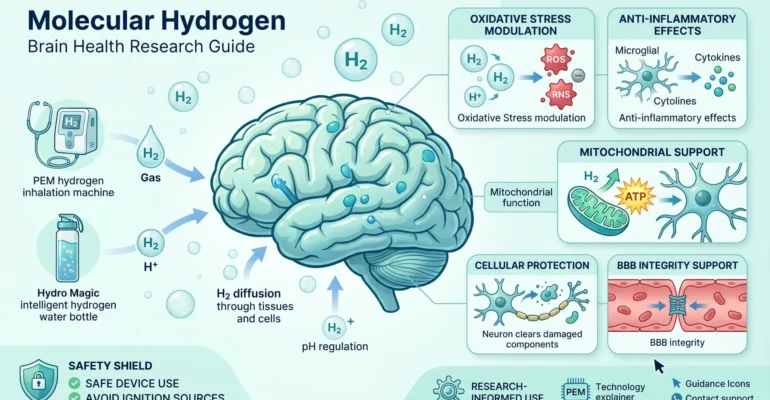
The 2021 critical review on neuroprotective effects is directly relevant to molecular hydrogen and brain health. It reports that H2 has been studied in nervous system disorders such as ischemia-reperfusion injury, traumatic injury, subarachnoid hemorrhage, neuropathic pain, neurodegenerative diseases, cognitive dysfunction linked to surgery and anesthesia, anxiety, and depression. The review also highlights possible mechanisms, including anti-oxidation, anti-inflammation, anti-apoptosis, autophagy regulation, mitochondrial preservation, and blood-brain barrier support.
https://pubmed.ncbi.nlm.nih.gov/33078374/
https://pmc.ncbi.nlm.nih.gov/articles/PMC7954968/
This does not mean H2 is a proven treatment for these conditions. It means researchers are studying whether hydrogen can influence pathways involved in brain injury and neurological stress. For example, mitochondrial function is important because neurons need stable energy production. Blood-brain barrier protection is important because barrier disruption can worsen inflammation and brain tissue stress. Autophagy matters because cells use it to clear damaged components. These mechanisms make H2 research scientifically plausible, but clinical proof still depends on condition-specific trials.
People comparing products should therefore ask practical questions. Is the device designed for hydrogen inhalation? Does the brand explain safe use clearly? Are accessories available? Is there a support page or tutorial page? Health and Hydrogen provides product pages for models such as the HAH 3000, HAH 1800, HAH 900, and HAH 450, along with accessories and supporting videos.
https://healthandhydrogen.com/hah-3000/
https://healthandhydrogen.com/hah-1800/
https://healthandhydrogen.com/hah-900/
https://healthandhydrogen.com/hah-450/
https://healthandhydrogen.com/accessories-for-hydrogen-inhalation-machines/
https://healthandhydrogen.com/video-session/
Molecular Hydrogen, Social Behavior, and Depression-Like Research
One of the studies you provided investigated molecular hydrogen in a mouse model of blast-induced mild traumatic brain injury. The study title reports that molecular hydrogen prevented social deficits and depression-like behaviors induced by low-intensity blast in mice. This is an animal study, so it cannot be directly translated into claims for people with depression, PTSD, military blast exposure, or traumatic brain injury.
https://pubmed.ncbi.nlm.nih.gov/30053086/
The value of this study is that it connects hydrogen research with behavior-related outcomes, not only laboratory biomarkers. It also fits a broader research pattern in which oxidative stress, inflammation, and mitochondrial stress are studied in relation to mood, cognition, and brain injury. However, human mental health conditions are complex. They require professional assessment, evidence-based care, and sometimes medication, therapy, rehabilitation, or emergency support. Hydrogen wellness products should never be presented as a substitute for mental health treatment.
Hydrogen Inhalation Machine vs Hydrogen Water
Hydrogen can be delivered in several ways, including inhaled hydrogen gas, hydrogen-rich water, hydrogen-rich saline in clinical settings, baths, topical methods, and emerging delivery systems. The best option depends on the purpose, setting, user preference, and available safety guidance. Inhalation is often used when people want direct H2 gas delivery, while hydrogen water is a convenient daily wellness option. Human clinical reviews include multiple delivery routes rather than one single standard method.
https://www.mdpi.com/1420-3049/28/23/7785
https://pubmed.ncbi.nlm.nih.gov/33078374/
Health and Hydrogen offers hydrogen inhalation machines and the Hydro Magic Intelligent Hydrogen Water Bottle. The HAH 3000 product page lists the HAH3000 model as a hydrogen inhaler with adjustable flow settings and 99.99% hydrogen purity. The HAH 1800 page lists adjustable flow rates and SPE and PEM technology, while HAH 900 and HAH 450 pages describe smaller hydrogen inhaler options. The Hydro Magic page lists a hydrogen water bottle with 2000 to 9000 ppb hydrogen level, according to the product page.
https://healthandhydrogen.com/hah-3000/
https://healthandhydrogen.com/hah-1800/
https://healthandhydrogen.com/hah-900/
https://healthandhydrogen.com/hah-450/
https://healthandhydrogen.com/hah-hm350/
Safety First: What Buyers Should Know
Hydrogen gas safety must be discussed clearly. The Molecular Hydrogen Institute states that hydrogen gas is highly flammable between about 4% and 75% concentration by volume in air, and that product choice should minimize risk. The Health and Hydrogen HAH 3000 operating manual also warns users to keep the device away from fire, avoid smoking or open flames during use, maintain space around the machine, keep it in a ventilated area, avoid unauthorized disassembly, and turn off power before cleaning or maintenance.
https://molecularhydrogeninstitute.org/is-molecular-hydrogen-safe/
https://healthandhydrogen.com/wp-content/uploads/HAH-3000-Operating-Manual-Updated-2024.pdf
This is why buyers should not choose a hydrogen inhalation machine based only on flow rate or price. They should also check the manual, water requirements, accessories, maintenance steps, support availability, warranty information, and tutorials. People with neurological disease, cancer, cardiovascular disease, respiratory disease, pregnancy, implanted medical devices, or any serious medical condition should speak with a qualified healthcare professional before beginning hydrogen use. For device-specific questions, contact Health and Hydrogen support.
https://healthandhydrogen.com/support/
https://healthandhydrogen.com/faqs/
https://healthandhydrogen.com/contact/
How to Choose a Hydrogen Device for Wellness Use
A good hydrogen device decision should start with your use case. A clinic or wellness center may prefer a higher-capacity hydrogen inhalation machine with adjustable flow and clear service support. A home user may prefer a simpler model or hydrogen water option. Someone focused on regular wellness routines may value ease of cleaning, accessories, tutorial videos, and support more than maximum output.
The second factor is technology. Health and Hydrogen states that its inhalation devices use PEM technology, and product pages describe SPE and PEM technology for some models. PEM stands for Proton Exchange Membrane, and in consumer hydrogen devices it is commonly discussed in relation to gas separation and purity. Buyers should rely on each product page and operating manual rather than assumptions from generic online claims.
https://healthandhydrogen.com/
https://healthandhydrogen.com/hah-1800/
The third factor is education. Since molecular hydrogen research is still evolving, the best buying experience is not just “add to cart.” It should include learning what H2 is, what the evidence can and cannot say, how to use the device, and when to ask a professional. Health and Hydrogen’s FAQ, support, blog, and video session pages can help customers move from curiosity to safer, better-informed use.
https://healthandhydrogen.com/faqs/
https://healthandhydrogen.com/blogs/
https://healthandhydrogen.com/video-session/
https://healthandhydrogen.com/support/
FAQs
1. What is molecular hydrogen?
Molecular hydrogen is H2, a small neutral gas made of two hydrogen atoms. It is being studied for possible effects on oxidative stress, inflammation, mitochondria, apoptosis, and cellular signaling.
https://pubmed.ncbi.nlm.nih.gov/31738389/
2. Is molecular hydrogen the same as hydrogen ion dynamics?
No. Molecular hydrogen is H2 gas. Hydrogen ion dynamics refers to H+ movement and pH regulation. The 2022 paper you provided focuses on pH, cellular acid-base balance, cancer, neurodegeneration, and multiple sclerosis.
https://pubmed.ncbi.nlm.nih.gov/35269597/
3. Can hydrogen inhalation treat neurodegenerative disease?
Current research is promising, but it does not prove that hydrogen inhalation treats or cures neurodegenerative disease. Anyone with a diagnosed condition should consult a qualified healthcare professional.
https://pubmed.ncbi.nlm.nih.gov/33078374/
4. Why is molecular hydrogen studied for brain health?
It is studied because the brain is sensitive to oxidative stress, inflammation, mitochondrial dysfunction, and blood-brain barrier injury. Reviews suggest H2 may influence several of these pathways.
https://pubmed.ncbi.nlm.nih.gov/33078374/
5. Is hydrogen water useful compared with inhalation?
Both are studied delivery methods. Hydrogen water may be convenient for daily wellness, while inhalation is used when people want gas delivery. The best choice depends on user needs, safety, and product guidance.
https://www.mdpi.com/1420-3049/28/23/7785
6. Is a hydrogen inhalation machine safe?
Hydrogen itself has a strong safety profile when used properly, but hydrogen gas is flammable at certain concentrations in air. Always follow the product manual, avoid flames and smoking, maintain ventilation, and use original accessories.
https://molecularhydrogeninstitute.org/is-molecular-hydrogen-safe/
https://healthandhydrogen.com/wp-content/uploads/HAH-3000-Operating-Manual-Updated-2024.pdf
7. Which Health and Hydrogen device should I choose?
For high-output needs, review the HAH 3000. For mid-range or smaller options, compare HAH 1800, HAH 900, and HAH 450. For hydrogen water, review Hydro Magic. Choose based on intended use, support, manual, budget, and professional guidance where needed.
https://healthandhydrogen.com/hah-3000/
https://healthandhydrogen.com/hah-1800/
https://healthandhydrogen.com/hah-900/
https://healthandhydrogen.com/hah-450/
https://healthandhydrogen.com/hah-hm350/
8. Can I use hydrogen instead of medication?
No. Hydrogen products should not replace prescribed medication, medical treatment, mental health care, cancer care, neurological care, or emergency care. They should be considered only as wellness or adjunctive options when appropriate.
9. What should I check before buying?
Check hydrogen output, technology, water requirements, accessories, cleaning instructions, manual warnings, warranty/support, tutorials, and whether the device fits your intended setting. Health and Hydrogen provides support and product pages for comparison.
https://healthandhydrogen.com/shop
https://healthandhydrogen.com/support/
10. Where can I ask product-specific questions?
You can contact Health and Hydrogen directly through the contact or support pages. This is especially useful if you are unsure which device, accessory, or maintenance routine fits your situation.
https://healthandhydrogen.com/contact/
https://healthandhydrogen.com/support/
Conclusion
Molecular hydrogen and brain health is a serious and growing research topic. The strongest scientific themes from the sources you provided are oxidative stress, inflammation, mitochondrial function, apoptosis, autophagy, blood-brain barrier support, pH biology, and neuroprotection. The 2022 hydrogen ion dynamics paper adds an important acid-base perspective, while the molecular hydrogen reviews show why H2 gas is being studied across neurological and systemic conditions. But the correct conclusion is balanced: promising science, not proven cure.
For buyers, the best next step is to choose education before purchase. Learn the difference between hydrogen water and hydrogen inhalation. Read the device manual. Follow safety instructions. Avoid open flames and smoking during use. Speak with a qualified healthcare professional if you have any medical condition. Then compare Health and Hydrogen devices and support resources based on your real needs, not hype.
Soft CTA
Explore Health and Hydrogen’s hydrogen inhalation machines, hydrogen water products, accessories, support resources, and tutorials to make a safer, more informed decision for your wellness routine.
https://healthandhydrogen.com/shop
https://healthandhydrogen.com/
Search
Categories
- ANI NEWS (1)
- AP NEWS (1)
- Applications (26)
- Beauty Clinics (1)
- BENZINGA ESPANA (1)
- BOLSAMANIA (1)
- Brain cancer (14,615)
- Breast Cancer (12,744)
- Cervical Cancer (11,502)
- Cision (1)
- Colon Cancer (11,405)
- EUROPA PRESS (1)
- FINANZEN (1)
- Genetic and Congenital Disorders (195)
- Hydrogen Inhalation Machine (15,420)
- Hydrogen Inhalation Therapy (11,414)
- Infectious Diseases (242)
- Lung Cancer (11,505)
- News (8)
- Non Alcoholic Fatty Liver (11,504)
- Ovarian Cancer (11,506)
- Oxidative Stress (2)
- Pancreatic cancer (11,505)
- Parkinson's disease (10,167)
- Post Covid (11,504)
- PR Newswire (1)
- Press Release (13)
- Seeking Alpha (1)
- The Print (1)
- The Times of India (1)
- Uncategorized (9)
- WALLSTREET ONLINE (1)
- ZEE 5 (1)