Molecular Hydrogen Cancer Research: What Science Says
May 14, 2026 2026-05-14 5:06Molecular Hydrogen Cancer Research: What Science Says
Molecular Hydrogen Cancer Research: What Science Says
Written by clinical researcher, Dr. Aamir Sohail, PhD in Biochemistry and Molecular Biology: aamir.sohail@oncofit.in
Introduction
Many people searching for a hydrogen inhalation machine are not only looking for wellness support. They are also asking a serious question: what does molecular hydrogen cancer research actually show? This is an important question because cancer-related content must be handled with care. Molecular hydrogen is being studied for its effects on oxidative stress, inflammation, cell signaling, and tumor biology, but it should not be presented as a cure, treatment, or replacement for oncology care.
For Health and Hydrogen, the right approach is education first. Hydrogen inhalation machines, hydrogen water products, PEM/SPE hydrogen technology, accessories, warranty, and support should be discussed honestly, with a clear difference between scientific research and medical claims. Customers with cancer, a history of cancer, or any serious medical condition should consult a qualified healthcare professional before using hydrogen products.
https://healthandhydrogen.com/
https://www.fda.gov/regulatory-information/search-fda-guidance-documents/general-wellness-policy-low-risk-devices
https://www.ftc.gov/business-guidance/resources/health-products-compliance-guidance
Quick Answer
Molecular hydrogen cancer research suggests that hydrogen gas may influence oxidative stress, inflammation, apoptosis, gene expression, and tumor-related pathways in laboratory, animal, and early clinical or real-world studies. However, this evidence is not enough to claim that hydrogen inhalation treats, prevents, or cures cancer. Hydrogen products should be used as wellness tools only, with medical guidance, proper safety practices, and realistic expectations.
Key Takeaways
- Molecular hydrogen is being studied in oncology because it may affect oxidative stress, inflammation, and cellular signaling.
- Some lung cancer and glioblastoma studies reported anti-tumor effects in cells and animals, not definitive proof in humans.
- Reviews describe hydrogen as promising, but still early and not a replacement for surgery, chemotherapy, radiation, immunotherapy, or medical care.
- Hydrogen gas safety depends on device design, concentration, ventilation, correct use, and avoiding ignition risks.
- PEM/SPE technology is important because it helps separate hydrogen generation and supports cleaner hydrogen delivery.
- Health and Hydrogen buyers should compare machines based on intended use, flow rate, support, warranty, accessories, and safety instructions.
- Anyone with cancer or a serious health condition should speak with a qualified healthcare professional before using hydrogen inhalation.
What Is Molecular Hydrogen?
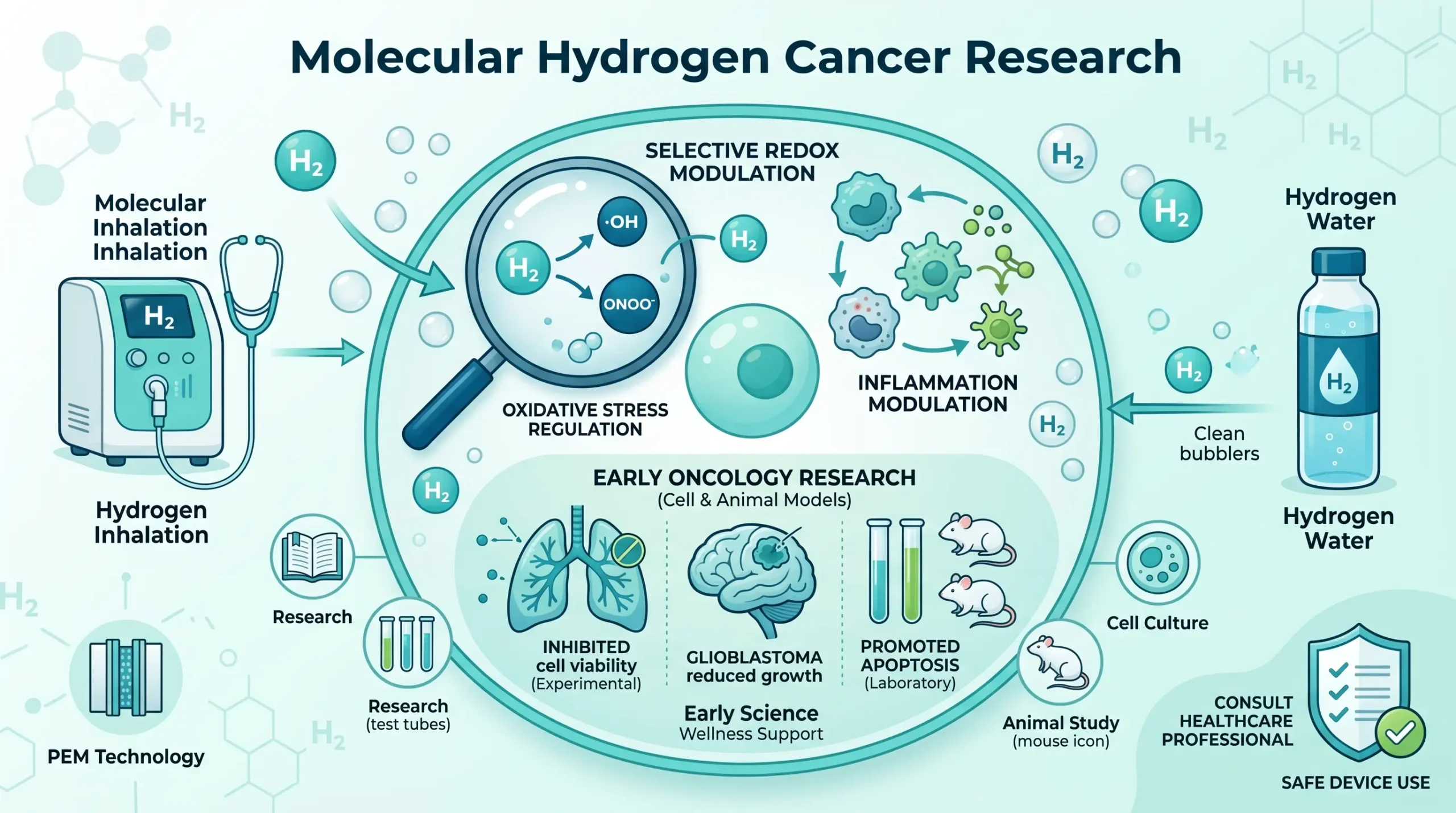
Molecular hydrogen, written as H2, is the smallest molecule in nature. Because of its very small size, it can diffuse rapidly through tissues and cell membranes. In medical research, it has been studied as a gas, hydrogen-rich water, hydrogen-rich saline, and other delivery formats. Researchers are interested in hydrogen because it may act as a selective redox modulator rather than a broad, harsh antioxidant.
https://www.frontiersin.org/journals/oncology/articles/10.3389/fonc.2019.00696/full
In simple terms, molecular hydrogen may help regulate oxidative stress without blocking every reactive oxygen species. This matters because not all reactive oxygen species are bad. Some are needed for normal immune function, cell signaling, and repair. The research interest is focused on whether hydrogen can reduce harmful oxidative stress while supporting normal biological balance.
https://pubmed.ncbi.nlm.nih.gov/34445428/
Why Is Molecular Hydrogen Being Studied in Cancer?
Cancer development is complex. It can involve DNA mutations, mitochondrial dysfunction, chronic inflammation, oxidative stress, immune escape, abnormal cell growth, and changes in gene expression. A 2021 review titled “Molecular Hydrogen as a Novel Antitumor Agent” discusses hydrogen’s possible role in scavenging hydroxyl radicals and influencing biological defense mechanisms through gene expression regulation.
https://pubmed.ncbi.nlm.nih.gov/34445428/
https://www.mdpi.com/1422-0067/22/16/8724
This does not mean hydrogen is proven to treat cancer. It means researchers are exploring whether hydrogen can affect conditions inside the body that are connected with cancer biology. The most responsible interpretation is that molecular hydrogen cancer research is promising but still developing. Stronger human clinical trials are needed before any disease-treatment claims can be made.
https://www.frontiersin.org/journals/oncology/articles/10.3389/fonc.2019.00696/full
What Does the Research Say About Hydrogen and Lung Cancer?
One of the important studies provided for this blog is “Hydrogen gas inhibits lung cancer progression through targeting SMC3.” This study investigated lung cancer cell lines, including A549 and H1975 cells. The researchers reported that hydrogen gas inhibited cell viability, migration, and invasion, promoted apoptosis, and affected cell-cycle regulation. The study also discussed SMC3 as a target connected with chromosome cohesion and cancer progression.
https://pubmed.ncbi.nlm.nih.gov/29852353/
https://www.sciencedirect.com/science/article/abs/pii/S0753332218308667
This is scientifically interesting because migration and invasion are important features of cancer progression. However, the study should not be translated into a consumer claim that a hydrogen inhalation machine treats lung cancer. Cell and animal findings are early-stage evidence. They help researchers design better studies, but they do not replace clinical trials in patients.
https://www.frontiersin.org/journals/oncology/articles/10.3389/fonc.2019.00696/full
For readers comparing hydrogen inhalation machines, the practical takeaway is careful and balanced: hydrogen gas is being researched in lung cancer biology, but products should be positioned for molecular hydrogen wellness and research education, not cancer treatment. People with lung cancer, respiratory disease, or oxygen-related medical needs should consult their physician before using any inhalation device.
https://healthandhydrogen.com/support/
https://healthandhydrogen.com/contact/
What Does the Research Say About Hydrogen and Glioblastoma?
Another major study provided is “Molecular hydrogen suppresses glioblastoma growth via inducing the glioma stem-like cell differentiation.” Glioblastoma is an aggressive brain tumor. In this study, researchers used animal models and cell models. Animals inhaled 67% hydrogen gas for one hour, two times per day. The study reported suppression of tumor growth, longer survival in mice, reduced markers related to stemness and proliferation, and increased GFAP, a marker associated with differentiation.
https://link.springer.com/article/10.1186/s13287-019-1241-x
The study also reported that hydrogen treatment reduced sphere-forming ability, migration, invasion, and colony-forming ability in glioma cells. These findings are important because glioma stem-like cells are linked with tumor recurrence, invasion, and resistance to therapy. Still, this was not a consumer product trial, and the hydrogen exposure conditions in the study should not be copied without medical and research supervision.
https://link.springer.com/article/10.1186/s13287-019-1241-x
The correct conclusion is that hydrogen may be worth further investigation in glioblastoma research. It is not proof that home hydrogen inhalation treats brain cancer. A person with glioblastoma or any neurological cancer should follow their oncology team’s treatment plan and discuss any wellness technology before use.
https://link.springer.com/article/10.1186/s13287-019-1241-x
https://healthandhydrogen.com/faqs/
Anti-Inflammatory and Anti-Tumor Mechanisms: What Might Be Happening?
The review “Anti-inflammatory and Antitumor Action of Hydrogen via Reactive Oxygen Species” explains that hydrogen has attracted attention because it may interact with reactive oxygen species and inflammation. In cancer biology, inflammation can support tumor development, angiogenesis, immune suppression, and treatment resistance. Hydrogen’s possible role as a redox and inflammation modulator is one reason researchers continue to study it.
https://pubmed.ncbi.nlm.nih.gov/30127861/
https://pmc.ncbi.nlm.nih.gov/articles/PMC6096066/
Hydrogen research often discusses hydroxyl radicals and peroxynitrite. These are highly reactive molecules that can damage DNA, proteins, and lipids. The scientific interest is not simply that hydrogen is an “antioxidant.” The more accurate explanation is that hydrogen may influence oxidative stress, antioxidant enzymes, inflammation-related cytokines, apoptosis, and gene expression. This makes it biologically interesting, but also complex.
https://www.frontiersin.org/journals/oncology/articles/10.3389/fonc.2019.00696/full
https://pubmed.ncbi.nlm.nih.gov/34445428/
This complexity is important for buyers. A simple claim like “hydrogen kills cancer cells” is not responsible. A better statement is: molecular hydrogen is being studied for its potential effects on oxidative stress, inflammation, apoptosis, and tumor-related signaling, but human evidence is still limited and should be interpreted cautiously.
https://www.ftc.gov/business-guidance/resources/health-products-compliance-guidance
What Does the Hydrogen Oncology Review Say?
The narrative review “A narrative review of hydrogen oncology: from real world survey to real world evidence” discusses the growing use of hydrogen products in cancer-related contexts and reports a real-world survey involving 82 patients with good cancer control using hydrogen products. Real-world observations can be useful for generating research questions, but they are not the same as randomized controlled clinical trials.
https://pubmed.ncbi.nlm.nih.gov/33004711/
https://pmc.ncbi.nlm.nih.gov/articles/PMC8086626/
This distinction matters. Real-world evidence can show patterns, patient experiences, and possible signals. It cannot fully remove bias, placebo effects, selection bias, differences in cancer type, differences in standard treatment, or differences in device use. For Health and Hydrogen, the ethical message should be clear: the research is encouraging, but it should be discussed as emerging science, not as proof of treatment.
https://pubmed.ncbi.nlm.nih.gov/33004711/
Is Hydrogen Inhalation Safe?
Hydrogen itself has a high biological safety profile in many research settings, but hydrogen gas is flammable at certain concentrations in air. The Molecular Hydrogen Institute notes that hydrogen gas is flammable between about 4% and 75% concentration by volume. This does not mean every hydrogen product is unsafe. It means users should follow device instructions, keep equipment away from flames or sparks, use proper ventilation, and choose devices designed with safety in mind.
https://molecularhydrogeninstitute.org/is-molecular-hydrogen-safe/
https://molecularhydrogeninstitute.org/flammability-risks-of-hydrogen-inhalation/
Safety is also about correct use. Users should not modify machines, block vents, use incorrect water, ignore maintenance, or combine accessories in ways not recommended by the manufacturer. Hydrogen inhalation should be used according to the product manual. People with lung disease, oxygen therapy needs, implanted medical devices, active cancer treatment, pregnancy, or serious illness should seek professional medical advice first.
https://healthandhydrogen.com/support/
https://healthandhydrogen.com/video-session/
Why PEM/SPE Technology Matters
Health and Hydrogen states that its inhalation devices use PEM technology. PEM stands for Proton Exchange Membrane, and SPE stands for Solid Polymer Electrolyte. In hydrogen generation, these technologies are used to help separate hydrogen and oxygen during water electrolysis. For buyers, PEM/SPE is important because it relates to gas purity, device design, water requirements, and stable performance.
https://healthandhydrogen.com/
https://healthandhydrogen.com/understanding-flow-rates-of-hydrogen-inhalation-machines/
Health and Hydrogen also explains that hydrogen is very light and may not be easily felt during use. A user may not feel a strong flow even when the machine is operating. The company’s flow-rate guidance explains that PEM electrolyzer output may stabilize gradually after settings are changed, so users should follow the manual and allow the machine to stabilize before judging output.
https://healthandhydrogen.com/understanding-flow-rates-of-hydrogen-inhalation-machines/
How to Choose a Hydrogen Inhalation Machine Responsibly
Choosing a hydrogen inhalation machine should not start with the highest number or the biggest claim. It should start with intended use, safety, support, warranty, accessories, and whether the machine fits the user’s environment. Health and Hydrogen offers different inhalation models, including HAH 450, HAH 900, HAH 1800, and HAH 3000, along with a hydrogen water bottle and accessories.
https://healthandhydrogen.com/shop
https://healthandhydrogen.com/hah-450/
https://healthandhydrogen.com/hah-900/
https://healthandhydrogen.com/hah-1800/
https://healthandhydrogen.com/hah-3000/
https://healthandhydrogen.com/hah-hm350/
The HAH 3000 product page lists adjustable total flow settings and separates hydrogen and oxygen outputs. The HAH 1800, HAH 900, and HAH 450 pages describe different flow capacities and SPE/PEM technology. Buyers should review the exact product page, operating manual, water requirements, accessories, and support options before purchasing.
https://healthandhydrogen.com/hah-3000/
https://healthandhydrogen.com/hah-1800/
https://healthandhydrogen.com/hah-900/
https://healthandhydrogen.com/hah-450/
For home users, a lower or mid-range machine may be enough depending on the intended wellness routine. For clinics, wellness centers, or multi-user environments, higher-capacity machines may be more practical. The decision should be based on product specifications and support, not on unsupported disease claims.
https://healthandhydrogen.com/contact/
https://healthandhydrogen.com/login-helpdesk
Hydrogen Water and Cancer Research
Hydrogen water is another delivery method discussed in hydrogen research. Some studies and reviews include hydrogen-rich water in discussions of oxidative stress, inflammation, chemotherapy-related side effects, and animal cancer models. However, hydrogen water should also be positioned carefully. It is not a cancer treatment, and its hydrogen concentration, stability, timing, and usage pattern can vary.
https://www.frontiersin.org/journals/oncology/articles/10.3389/fonc.2019.00696/full
Health and Hydrogen offers the Hydro Magic Intelligent Hydrogen Water Bottle. Its product page lists hydrogen level, bottle capacity, materials, battery capacity, and other specifications. Buyers interested in hydrogen water should review the product details and understand that wellness use is different from clinical cancer treatment.
https://healthandhydrogen.com/hah-hm350/
FAQs
1. Can molecular hydrogen cure cancer?
No. Current molecular hydrogen cancer research does not prove that hydrogen cures cancer. Some studies show interesting effects in cells, animals, reviews, and early real-world observations, but this is not enough to make cancer treatment claims.
https://pubmed.ncbi.nlm.nih.gov/34445428/
2. Is hydrogen inhalation a replacement for chemotherapy, radiation, surgery, or immunotherapy?
No. Hydrogen inhalation should not replace standard oncology care. Anyone with cancer should follow their medical team’s treatment plan and discuss hydrogen products with a qualified healthcare professional.
https://molecularhydrogeninstitute.org/is-molecular-hydrogen-safe/
3. Why are researchers studying hydrogen in oncology?
Researchers are studying hydrogen because it may influence oxidative stress, inflammation, apoptosis, gene expression, and tumor-related signaling. These mechanisms are relevant to cancer biology, but research is still developing.
https://www.frontiersin.org/journals/oncology/articles/10.3389/fonc.2019.00696/full
4. What did the lung cancer study show?
The lung cancer study reported that hydrogen gas inhibited cancer cell viability, migration, and invasion, promoted apoptosis, and affected SMC3-related pathways in experimental models. These findings are not proof of clinical cancer treatment.
https://pubmed.ncbi.nlm.nih.gov/29852353/
5. What did the glioblastoma study show?
The glioblastoma study reported that hydrogen inhalation suppressed tumor growth in animal models and affected stemness, proliferation, angiogenesis, differentiation, migration, and invasion markers. More clinical research is needed.
https://link.springer.com/article/10.1186/s13287-019-1241-x
6. Is hydrogen gas dangerous?
Hydrogen gas can be flammable at certain concentrations in air, especially around ignition sources. Safe use depends on product design, correct setup, ventilation, and following the manual.
https://molecularhydrogeninstitute.org/flammability-risks-of-hydrogen-inhalation/
7. What is the difference between hydrogen inhalation and hydrogen water?
Hydrogen inhalation delivers hydrogen gas through a device and accessories such as cannulas. Hydrogen water contains dissolved molecular hydrogen for drinking. Both are studied, but they differ in delivery, concentration, timing, and product design.
https://healthandhydrogen.com/hah-hm350/
https://healthandhydrogen.com/hah-3000/
8. Which Health and Hydrogen machine should I choose?
The best choice depends on your intended use, environment, flow needs, budget, accessories, support, and warranty expectations. Compare the HAH 450, HAH 900, HAH 1800, and HAH 3000 product pages before buying.
https://healthandhydrogen.com/shop
9. Can I use hydrogen inhalation during cancer treatment?
Do not start hydrogen inhalation during cancer treatment without speaking to your oncologist or qualified healthcare professional. Your doctor can advise based on your diagnosis, treatment plan, oxygen needs, medications, and overall condition.
https://healthandhydrogen.com/contact/
10. Does higher flow always mean better results?
Not necessarily. Higher flow does not automatically mean better results for every user. Device selection should consider intended use, safety, comfort, support, manual instructions, and professional advice when medical conditions are present.
https://healthandhydrogen.com/understanding-flow-rates-of-hydrogen-inhalation-machines/
Conclusion
Molecular hydrogen cancer research is an important and growing field. The studies provided for this article show possible effects on oxidative stress, inflammation, apoptosis, gene expression, lung cancer models, glioblastoma models, and real-world oncology observations. However, the responsible conclusion is clear: molecular hydrogen is promising for research, but it is not proven to cure, treat, or prevent cancer.
For buyers, this balanced view is actually helpful. It allows you to explore hydrogen inhalation machines and hydrogen water products with realistic expectations. The goal should be safe, informed wellness use, not replacing medical treatment. Always follow the product manual, use correct water and accessories, avoid unsafe modifications, and contact support when you have product-specific questions.
Health and Hydrogen supports customers with PEM/SPE hydrogen inhalation machines, hydrogen water products, accessories, FAQs, support, and video guidance. To compare models and choose responsibly, visit the Health and Hydrogen shop or contact the support team before purchasing.
https://healthandhydrogen.com/shop
https://healthandhydrogen.com/support/
https://healthandhydrogen.com/contact/