Hydrogen Inhalation Machine Guide: HAH-1800
May 14, 2026 2026-05-14 9:01Hydrogen Inhalation Machine Guide: HAH-1800
Hydrogen Inhalation Machine Guide: HAH-1800
Written by clinical researcher, Dr. Aamir Sohail, Ph.D. in Biochemistry and Molecular Biology: aamir.sohail@oncofit.in
Table of Contents
ToggleIntroduction
Buying a hydrogen inhalation machine can feel confusing because many people want to understand three things before they invest: how the machine works, whether it is safe to use at home, and what the science actually says about molecular hydrogen. The HAH-1800 is designed for users who want a higher-flow hydrogen inhalation device with practical home-use features, but it should still be used carefully, according to the operating manual, and not as a replacement for medical care. The HAH-1800 product page lists it as a 1.8L hydrogen inhaler with adjustable flow rates of 900, 1200, and 1800 ml/min, using SPE and PEM technology.
https://healthandhydrogen.com/hah-1800/
This guide explains the HAH-1800 hydrogen inhalation machine in simple language: what it does, how to set it up, how to use <1 TDS water, how to follow safety precautions, how to care for the cannula pieces, and how to think about the current research without exaggerating claims. Most of the practical guidance below comes directly from the HAH-1800 Operating Manual, including setup, water requirements, control panel operation, daily care, maintenance, and after-sales support.
https://healthandhydrogen.com/wp-content/uploads/HAH-1800-Operating-Manual-Updated.pdf
Quick Answer
A hydrogen inhalation machine produces molecular hydrogen gas for breathing through a nasal cannula or accessory system. The HAH-1800 provides adjustable flow settings up to 1800 ml/min, with the highest setting described in the manual as approximately 1200 ml/min molecular hydrogen and 600 ml/min oxygen. It requires <1 TDS water, correct ventilation, fire safety, routine cleaning, and careful use according to the manual.
https://healthandhydrogen.com/hah-1800/
https://healthandhydrogen.com/wp-content/uploads/HAH-1800-Operating-Manual-Updated.pdf
Key Takeaways
- The HAH-1800 is a high-flow hydrogen inhalation device with adjustable 900, 1200, and 1800 ml/min settings.
- The manual describes the 1800 ml/min setting as approximately 66% hydrogen and 33% oxygen.
- <1 TDS water is essential for setup and top-ups because impurities can reduce performance and shorten machine lifespan.
- The device must be kept away from fire, smoking, open flames, blocked gas outlets, and poor ventilation.
- The machine should not run continuously for more than 8 hours without a 1-hour cooling break.
- Cannula pieces, the water trap, and the bubbler cup need regular user care to reduce moisture and contamination risk.
- Molecular hydrogen research is promising, but it should not be interpreted as proof that hydrogen inhalation treats or cures disease.
What Is a Hydrogen Inhalation Machine?
A hydrogen inhalation machine is a device that generates molecular hydrogen gas, usually through electrolysis, so the user can inhale hydrogen through a nasal cannula or related accessory. In simple terms, the machine uses water and an internal system to produce gas for inhalation. Hydrogen inhalation is different from an oxygen concentrator because the goal is not only oxygen support. The focus is molecular hydrogen exposure, often discussed in wellness and research contexts because hydrogen is being studied for oxidative stress, inflammation-related pathways, and cellular signalling.
https://pubmed.ncbi.nlm.nih.gov/38067515/
The HAH-1800 is positioned by Health and Hydrogen as a hydrogen inhaler with 1.8L output and adjustable flow rates. The product page states that it uses SPE and PEM technology and can also produce hydrogen water with a hydrogen rod. For buyers comparing hydrogen inhalation machines, this matters because the HAH-1800 is not only a breathing device. It also includes accessory-based functionality for hydrogen-rich water preparation.
https://healthandhydrogen.com/hah-1800/
Why the HAH-1800 Is Different From a Basic Low-Flow Device
The HAH-1800 Operating Manual lists several user-focused features, including one-click run, hydrogen only, oxygen only, oxy-hydrogen, flow rate adjustment, hydrogen water, beauty accessories, and 1 to 8 hour timing. The manual also lists product specifications such as 99.99% hydrogen, noise below 50 dB, 110V/220V voltage, and a compact body size. These details should be checked against the live product page before purchase because product design and specifications may be updated over time.
https://healthandhydrogen.com/wp-content/uploads/HAH-1800-Operating-Manual-Updated.pdf
On the HAH-1800 product page, Health and Hydrogen lists the machine as having adjustable flow rates of 900, 1200, and 1800 ml/min, product size 300 x 193 x 285 mm, net weight 8.5 kg, and function for hydrogen inhalation and hydrogen water with a hydrogen rod. This makes it suitable for users who want a more substantial home hydrogen inhalation machine rather than a small portable hydrogen bottle only.
https://healthandhydrogen.com/hah-1800/
HAH-1800 Flow Rate Explained
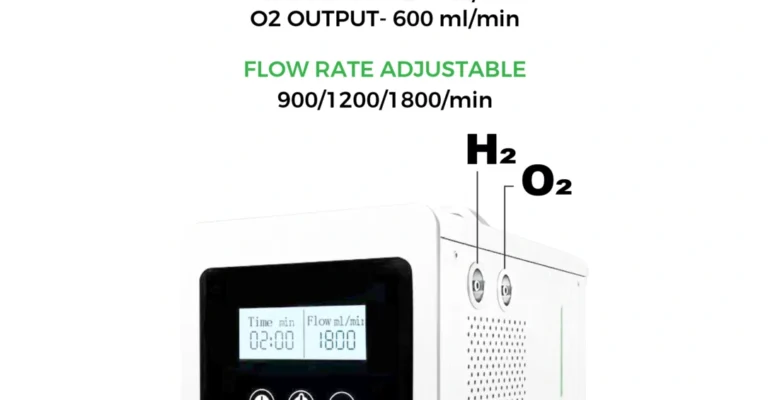
The control panel section of the manual explains that the right button selects the flow rate. The highest setting is 1800 ml/min and is described as providing approximately 66% hydrogen and 33% oxygen, equal to about 1200 ml/min molecular hydrogen and 600 ml/min oxygen. The manual also says users can choose lower flow options using the same button.
https://healthandhydrogen.com/wp-content/uploads/HAH-1800-Operating-Manual-Updated.pdf
This is important for searchers comparing hydrogen inhalation devices because “flow rate” is one of the most common buyer questions. A higher flow rate may allow a stronger machine output, but users should not assume that higher is always better for every person. Session time, comfort, health status, ventilation, and professional advice matter. Users with medical conditions, oxygen sensitivity concerns, respiratory disease, cardiovascular disease, pregnancy, or current medication use should speak with a qualified healthcare professional before use.
How to Set Up the HAH-1800 Correctly
The Getting Started Guide in the manual says to place the machine on a sturdy flat surface near a power point and prepare a clean cloth, funnel, Y tube piece, water bubbler cup, metal cup holder, clean pouring jug, and 2.5 litres or 85 ounces of <1 TDS water. It also tells users to read the setup steps before starting. This is good practical advice because many machine problems begin with rushed setup, overfilling, poor positioning, or using the wrong water.
https://healthandhydrogen.com/wp-content/uploads/HAH-1800-Operating-Manual-Updated.pdf
The manual instructs users to fill the bubbler cup slightly above the minimum line, attach the Y tube correctly to the bubbler inlet and gas outlets, connect the power, open the tank cover, and slowly add 2.5 litres of pure distilled water with less than 1 TDS. It then instructs users to drain water for about 15 to 20 seconds during first setup before replacing the plug and cap. This first-use drainage step is not required for every later top-up.
https://healthandhydrogen.com/wp-content/uploads/HAH-1800-Operating-Manual-Updated.pdf
For product-specific setup support, Health and Hydrogen also provides a support page and video session page. These are useful internal links for users who prefer visual instructions or need troubleshooting help after reading the manual.
https://healthandhydrogen.com/support/
https://healthandhydrogen.com/video-session/
Why <1 TDS Water Matters
One of the strongest practical messages in the HAH-1800 manual is that <1 TDS water is essential for setup and top-ups. TDS means total dissolved solids. In plain English, it tells you how many dissolved impurities are in the water. The manual says <1 TDS water, often called zero TDS water, provides optimal conditions for hydrogen production and that impurities can reduce both the quantity and purity of hydrogen produced while shortening the lifespan of the machine.
https://healthandhydrogen.com/wp-content/uploads/HAH-1800-Operating-Manual-Updated.pdf
The manual states that the initial tank fill plus bubbler cup setup requires about 2.6 litres or 85 fluid ounces in total. It also recommends keeping another 2.6 litres available for convenient top-ups during the first few weeks. This is a practical buyer point because the machine is not just a plug-in device. Users need the correct water and a simple water-management routine.
https://healthandhydrogen.com/wp-content/uploads/HAH-1800-Operating-Manual-Updated.pdf
How to Use the Control Panel
The HAH-1800 control panel has three main button functions. The right button controls flow rate. The middle button starts or pauses the session. The left clock button adjusts the timer and can also switch day or night mode when held for a few seconds. The timer options in the manual include 30 minutes, 1 hour, 2 hours, 4 hours, 6 hours, and 8 hours.
https://healthandhydrogen.com/wp-content/uploads/HAH-1800-Operating-Manual-Updated.pdf
The manual also explains screen error prompts. These include water low, TDS, overheat, and pressure alerts. For example, a water low prompt means water should be added in time, a TDS prompt means the water quality is not qualified and pure water should be replaced, an overheat prompt means the temperature is high and use should stop, and a pressure prompt means the hydrogen pressure is high and the user should check whether the suction pipe is bent or squeezed.
https://healthandhydrogen.com/wp-content/uploads/HAH-1800-Operating-Manual-Updated.pdf
Safety First: Fire, Ventilation, Heat, and Electricity
Hydrogen is a flammable gas, so safety should be explained clearly, not hidden. The Molecular Hydrogen Institute states that hydrogen gas is flammable in air at approximately 4% to 75% by volume, and that risk depends on concentration, mixing with air, ventilation, ignition sources, and system design. This means hydrogen inhalation safety is not only about the gas itself. It is about how the device is used, where it is used, and whether the user follows instructions.
https://molecularhydrogeninstitute.org/flammability-risks-of-hydrogen-inhalation/
The HAH-1800 manual gives direct safety instructions: keep the machine away from fire, do not smoke during use, do not allow open flames, do not block gas outlets, do not bend the nasal pipe, use the device in a well-ventilated indoor area, and keep it away from direct sunlight. The manual also says the room temperature should not be lower than 10°C or higher than 30°C during operation.
https://healthandhydrogen.com/wp-content/uploads/HAH-1800-Operating-Manual-Updated.pdf
Electrical safety also matters. The manual warns users not to insert or manipulate plugs with wet hands, not to use flammable cleaners or sprays on the product, not to disassemble or modify the equipment, and not to use an extension cord unless approved by local authorities. If there are abnormal sounds, burning smells, or smoke, users should disconnect power safely and contact technical support.
https://healthandhydrogen.com/wp-content/uploads/HAH-1800-Operating-Manual-Updated.pdf
How Long Can the HAH-1800 Run?
The manual advises that the machine should not operate continuously for more than 8 hours. After 8 hours of operation, the power should be turned off and the machine should rest for 1 hour to dissipate heat before restarting. This instruction is important for protecting the machine and reducing avoidable overheating risk.
https://healthandhydrogen.com/wp-content/uploads/HAH-1800-Operating-Manual-Updated.pdf
For most wellness users, this means the best approach is to treat hydrogen inhalation as a structured session rather than leaving the machine running without attention. A safe routine includes checking water level, checking the bubbler cup, confirming the tube is not bent, keeping the device ventilated, and following the timer settings.
Daily Care for Cannula Pieces and Accessories
The manual gives simple daily care instructions for the nostril pieces, water trap, and bubbler cup. It recommends wiping nostril pieces with an alcohol swab after each use, opening the water trap to release moisture and reduce bacterial growth, and checking that the bubbler cup is bubbling at the correct level each time the machine is turned on.
https://healthandhydrogen.com/wp-content/uploads/HAH-1800-Operating-Manual-Updated.pdf
The manual also warns about overfilling. If the machine is overfilled, excess water can come out through the oxygen outlet into the bubbler cup and may overflow into the cannula, potentially causing water to reach the nose. This is why users should top up slowly, ideally while the machine is on, so they can hear the voice prompt when the best water level is reached.
https://healthandhydrogen.com/wp-content/uploads/HAH-1800-Operating-Manual-Updated.pdf
For replacement parts and add-ons, Health and Hydrogen has an accessories page that includes items such as nasal cannulas, bubbler cups, hydrogen infusion rods, Y connectors, and other hydrogen therapy accessories. This is useful for customers who want to maintain hygiene or replace frequently used parts.
https://healthandhydrogen.com/accessories-for-hydrogen-inhalation-machines/
Routine Tank Maintenance
The HAH-1800 manual recommends a routine tank cleaning process once every 6 months. The process includes draining the water tank, filling it with 2.5 litres of pure <1 TDS water, draining it completely, repeating the process once more, and then refilling with 2.5 litres before draining for 15 to 20 seconds and restarting after the machine and area are dry.
https://healthandhydrogen.com/wp-content/uploads/HAH-1800-Operating-Manual-Updated.pdf
This maintenance routine is not just about cleanliness. It supports machine performance and user confidence. A hydrogen inhalation machine depends on water quality, clean tubing, unobstructed flow, and proper heat management. Users who want a low-stress experience should create reminders for water changes, tank cleaning, accessory replacement, and support checks.
What Does the Science Say About Molecular Hydrogen?
Molecular hydrogen research has expanded across human clinical studies, animal studies, and mechanistic research. A 2023 review in Molecules identified 81 clinical trials and 64 scientific publications on human hydrogen therapy studies, but the authors also discuss the need to interpret findings carefully because study designs, delivery methods, doses, and indications vary. This supports a balanced message: hydrogen is scientifically interesting, but not a proven cure-all.
https://pubmed.ncbi.nlm.nih.gov/38067515/
A 2025 review describes molecular hydrogen delivery methods including inhalation, hydrogen-rich water, and hydrogen solution injection, and discusses possible mechanisms such as oxidative stress modulation, inflammatory pathway regulation, and cell signalling effects. However, review-level evidence is not the same as product-level proof, and consumers should not assume that any hydrogen device treats a disease unless supported by proper clinical evidence and professional guidance.
https://pubmed.ncbi.nlm.nih.gov/40297245/
Safety literature also deserves attention. A 2019 paper on preventing explosions of hydrogen gas inhalers notes that hydrogen is odorless and flammable or explosive when ignited by static electricity, and discusses hydrogen concentration control for explosion prevention. This supports the practical safety instructions in the HAH-1800 manual, especially around open flames, ventilation, blocked outlets, and correct accessories.
https://pubmed.ncbi.nlm.nih.gov/31552881/
Hydrogen Inhalation vs Hydrogen Water
Hydrogen inhalation and hydrogen water are different delivery methods. The Molecular Hydrogen Institute explains that inhalation and drinking hydrogen-rich water are common routes, but their timing and pharmacokinetics differ. It also notes that inhalation can reach peak plasma levels in about 30 minutes, while hydrogen-rich water can produce a rise in breath hydrogen within 5 to 15 minutes depending on dosage.
https://molecularhydrogeninstitute.org/hydrogen-an-emerging-medical-gas/
The HAH-1800 manual includes instructions for making hydrogen-rich water using the hydrogen rod. The user connects the hydrogen rod to the tube, attaches the tube to the H outlet, places the rod fully into water, and turns on the machine. This feature may appeal to users who want both inhalation and hydrogen water functionality from one device, but users should follow Health and Hydrogen’s support guidance for quantities and timing.
https://healthandhydrogen.com/wp-content/uploads/HAH-1800-Operating-Manual-Updated.pdf
https://healthandhydrogen.com/support/
Who Is the HAH-1800 Best For?
The HAH-1800 may be suitable for wellness-focused users who want a home hydrogen inhalation machine with higher flow capacity, adjustable settings, hydrogen water support, and structured accessories. It may also interest biohacking users, longevity-focused buyers, wellness clinics, and customers who want a more powerful option than a basic hydrogen water bottle. Buyers can compare the HAH-1800 with other Health and Hydrogen devices through the shop page.
https://healthandhydrogen.com/shop/
https://healthandhydrogen.com/hah-1800/
However, suitability depends on the person. Anyone with a medical condition, respiratory disease, heart disease, pregnancy, oxygen-related concerns, implanted medical devices, or medication use should consult a qualified healthcare professional before starting hydrogen inhalation. The HAH-1800 should be viewed as a wellness and educational product unless a healthcare professional gives individual guidance.
Common Buyer Objections
One common concern is, “Will I feel gas coming out?” The HAH-1800 manual says it is normal to have no strong sensation in the nose when hydrogen gas is coming out. It explains that hydrogen breathing does not feel like an oxygen machine because oxygen machine airflow is generally several times stronger and cannot be compared directly.
https://healthandhydrogen.com/wp-content/uploads/HAH-1800-Operating-Manual-Updated.pdf
Another common concern is, “How do I know the machine is working?” The manual suggests placing the nasal cannula connected to the machine in a cup of water to check whether it bubbles well. This is a simple user test, but it should not replace troubleshooting support if the machine shows an error message, unusual sound, burning smell, water issue, TDS error, or pressure warning.
https://healthandhydrogen.com/wp-content/uploads/HAH-1800-Operating-Manual-Updated.pdf
For product-specific questions, Health and Hydrogen directs users to support resources, after-sales service, and contact options. The manual mentions contacting after-sales service for troubleshooting beyond the manual and support articles. Customers can also use the support, FAQs, and contact pages for help.
https://healthandhydrogen.com/support/
https://healthandhydrogen.com/faqs/
https://healthandhydrogen.com/contact/
How to Choose a Hydrogen Inhalation Machine
When comparing hydrogen inhalation machines, start with practical questions. What flow rate do you need? Do you want hydrogen water functionality? Is the machine easy to set up? Does it have clear safety instructions? Are accessories available? Is support easy to contact? Does the brand provide manuals, videos, FAQs, and warranty information? These questions are often more useful than choosing only by price.
https://healthandhydrogen.com/shop/
The HAH-1800 sits in the Health and Hydrogen product range alongside other models such as HAH-450, HAH-900, and HAH-3000. Buyers who want a lower-flow or higher-flow model should compare product pages carefully and contact support before purchase if they are unsure which model fits their usage pattern.
https://healthandhydrogen.com/hah-450/
https://healthandhydrogen.com/hah-900/
https://healthandhydrogen.com/hah-1800/
https://healthandhydrogen.com/hah-3000/
FAQs
1. What is the HAH-1800 hydrogen inhalation machine?
The HAH-1800 is a hydrogen inhalation device from Health and Hydrogen. It is listed as a 1.8L hydrogen inhaler with adjustable flow rates of 900, 1200, and 1800 ml/min, using SPE and PEM technology.
https://healthandhydrogen.com/hah-1800/
2. What water should I use in the HAH-1800?
The manual says <1 TDS water is essential for setup and top-ups. This is often called zero TDS water. Using water with impurities may reduce hydrogen production performance and shorten machine lifespan.
https://healthandhydrogen.com/wp-content/uploads/HAH-1800-Operating-Manual-Updated.pdf
3. How much water is needed for first setup?
The manual says the first tank fill uses 2.5 litres or 85 ounces of pure distilled water with less than 1 TDS. It also says the initial tank fill plus bubbler cup setup requires about 2.6 litres in total.
https://healthandhydrogen.com/wp-content/uploads/HAH-1800-Operating-Manual-Updated.pdf
4. Is hydrogen inhalation safe?
Hydrogen inhalation safety depends on device design, gas concentration, ventilation, correct use, and avoiding ignition sources. Hydrogen is flammable within certain concentration ranges in air, so users must follow the manual’s fire, ventilation, outlet, and electrical safety instructions.
https://molecularhydrogeninstitute.org/flammability-risks-of-hydrogen-inhalation/
https://healthandhydrogen.com/wp-content/uploads/HAH-1800-Operating-Manual-Updated.pdf
5. Can the HAH-1800 treat disease?
This blog does not claim that the HAH-1800 treats, cures, or prevents disease. Molecular hydrogen is being studied in clinical and mechanistic research, but users should speak with a qualified healthcare professional for medical advice.
https://pubmed.ncbi.nlm.nih.gov/38067515/
6. How do I know if the HAH-1800 is working?
The manual says users can place the connected nasal cannula in a cup of water to check if it is bubbling well. If there are error messages or unusual signs, contact Health and Hydrogen support.
https://healthandhydrogen.com/wp-content/uploads/HAH-1800-Operating-Manual-Updated.pdf
https://healthandhydrogen.com/support/
7. Can I use the HAH-1800 continuously overnight?
The manual says the machine should not operate continuously for more than 8 hours. After 8 hours, turn it off and allow a 1-hour cooling break before restarting.
https://healthandhydrogen.com/wp-content/uploads/HAH-1800-Operating-Manual-Updated.pdf
8. How often should I clean the tank?
The manual recommends routine tank cleaning once every 6 months. It also recommends changing water to clean the tank and flush impurities.
https://healthandhydrogen.com/wp-content/uploads/HAH-1800-Operating-Manual-Updated.pdf
9. Why do I not feel strong airflow from the cannula?
The manual says it is normal to have no strong gas-out feeling when hydrogen is coming out because hydrogen breathing does not feel like an oxygen machine.
https://healthandhydrogen.com/wp-content/uploads/HAH-1800-Operating-Manual-Updated.pdf
10. Where can I buy accessories?
Health and Hydrogen provides an accessories page for items such as nasal cannulas, bubbler cups, hydrogen infusion rods, and connectors.
https://healthandhydrogen.com/accessories-for-hydrogen-inhalation-machines/
Conclusion
A hydrogen inhalation machine should be chosen with both interest and caution. The HAH-1800 offers adjustable flow rates, hydrogen inhalation, hydrogen water support, clear control panel functions, and practical accessories. The strongest value of the device is not only its output, but also the structured setup, <1 TDS water guidance, safety warnings, error prompts, hygiene steps, and support resources provided by Health and Hydrogen.
The science around molecular hydrogen is promising, especially in research areas connected with oxidative stress and inflammation-related pathways, but it is still developing. The safest message is balanced: hydrogen inhalation may be an interesting wellness technology, but it should not be treated as a guaranteed therapy or substitute for professional medical care. Always follow the manual, use the correct water, keep the machine ventilated, avoid fire and smoking, clean accessories, and contact support when unsure.
To explore the HAH-1800 hydrogen inhalation machine, compare models, or ask product-specific questions, visit Health and Hydrogen’s product and support pages.
https://healthandhydrogen.com/hah-1800/
https://healthandhydrogen.com/shop/
https://healthandhydrogen.com/support/
Search
Categories
- ANI NEWS (1)
- AP NEWS (1)
- Applications (26)
- Beauty Clinics (1)
- BENZINGA ESPANA (1)
- BOLSAMANIA (1)
- Brain cancer (14,615)
- Breast Cancer (12,744)
- Cervical Cancer (11,502)
- Cision (1)
- Colon Cancer (11,405)
- EUROPA PRESS (1)
- FINANZEN (1)
- Genetic and Congenital Disorders (195)
- Hydrogen Inhalation Machine (15,420)
- Hydrogen Inhalation Therapy (11,414)
- Infectious Diseases (242)
- Lung Cancer (11,505)
- News (8)
- Non Alcoholic Fatty Liver (11,504)
- Ovarian Cancer (11,506)
- Oxidative Stress (2)
- Pancreatic cancer (11,505)
- Parkinson's disease (10,167)
- Post Covid (11,504)
- PR Newswire (1)
- Press Release (13)
- Seeking Alpha (1)
- The Print (1)
- The Times of India (1)
- Uncategorized (9)
- WALLSTREET ONLINE (1)
- ZEE 5 (1)