HAH-3000 Hydrogen Inhalation Machine Guide
May 14, 2026 2026-05-14 9:07HAH-3000 Hydrogen Inhalation Machine Guide
HAH-3000 Hydrogen Inhalation Machine Guide
Written by clinical researcher, Dr. Aamir Sohail, P.hD in biochemistry and molecular biology: aamir.sohail@oncofit.in.
The HAH-3000 hydrogen inhalation machine is designed for people who want a higher-output hydrogen inhalation device with adjustable flow, oxy-hydrogen delivery, hydrogen-only and oxygen-only options, hydrogen water capability, and guided safety features. For many buyers, the biggest question is not only “What does this machine do?” but also “How do I use it safely, how much maintenance does it need, and what does the science actually support?” This guide answers those questions using the HAH-3000 operating manual, Health and Hydrogen product information, and current molecular hydrogen safety and research literature.
https://healthandhydrogen.com/hah-3000/
Quick Answer
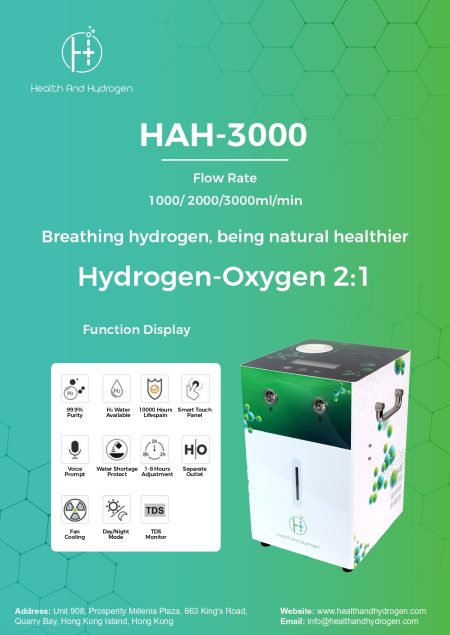
The HAH-3000 hydrogen inhalation machine is a high-output Health and Hydrogen device with three selectable total flow rates: 1000, 2000, and 3000 ml/min. At the highest setting, the official product page lists approximately 2000 ml/min hydrogen and 1000 ml/min oxygen. It is best suited for users who want a higher-capacity machine, but it must be used exactly as instructed, with zero or less than 1 TDS distilled water, good ventilation, proper accessories, and careful fire safety.
https://healthandhydrogen.com/hah-3000/
Key Takeaways
- The HAH-3000 is a higher-output hydrogen inhalation machine with 1000, 2000, and 3000 ml/min total flow options.
- At the 3000 ml/min setting, Health and Hydrogen lists hydrogen output at 2000 ml/min and oxygen output at 1000 ml/min.
- The operating manual strongly emphasizes fire safety, ventilation, upright placement, correct voltage, and original accessories.
- The machine requires distilled water with less than 1 TDS, often called zero TDS water.
- The manual recommends not running the machine continuously for more than 8 hours, with shorter continuous use in unusually hot weather.
- Molecular hydrogen research is promising, especially around oxidative stress and inflammation, but it should not be treated as proof of disease cure.
- Users with medical conditions should consult a qualified healthcare professional before starting hydrogen inhalation.
What Is the HAH-3000 Hydrogen Inhalation Machine?
The HAH-3000 hydrogen inhalation machine is a Health and Hydrogen device built for hydrogen gas inhalation and hydrogen water production. The HAH-3000 product page lists three adjustment flow settings: total flow 3000, 2000, and 1000 ml/min. It further breaks these down as hydrogen 2000, 1333, and 667 ml/min, and oxygen 1000, 667, and 333 ml/min. The same product page lists hydrogen purity as 99.99%, rated power under 500 watts, and power input options of AC110V 60Hz or AC220V 50Hz.
https://healthandhydrogen.com/hah-3000/
The attached HAH-3000 operating manual also describes one-click run, flow-rate adjustment, 1 to 8 timing options, hydrogen-only, oxygen-only, oxy-hydrogen, beauty accessories, and hydrogen water capability. It lists the product type as 99.99% hydrogen, noise under 50 dB, and voltage of 110V or 220V. One detail to check before purchase is product size: the manual lists 235 x 353 x 360 mm, while the product page lists 235 x 253 x 360 mm. If exact space planning matters, customers should confirm the current specification with Health and Hydrogen support before ordering.
https://healthandhydrogen.com/contact/
Why Buyers Compare Hydrogen Inhalation Machines
People comparing hydrogen inhalation machines usually look at output, ease of use, water requirements, accessories, maintenance, safety design, and support. A lower-output machine may be enough for occasional personal use, while higher-output models may be considered by users who want longer sessions, higher total flow, or multi-user suitability. Health and Hydrogen’s FAQ page gives similar buying guidance by explaining that lower-output machines such as 450 ml or 900 ml may suit personal, less frequent use, while higher-output machines such as 1.8 liter or 3 liter models may be considered for more intensive or multiple-user scenarios.
https://healthandhydrogen.com/faqs/
For comparison, Health and Hydrogen lists the HAH-900 as a 900 ml hydrogen inhaler with 600 ml/min hydrogen output and 300 ml/min oxygen output, while the HAH-450 is listed as a 450 ml hydrogen inhaler with 300 ml/min hydrogen output and 150 ml/min oxygen output. The HAH-1800 page lists adjustable flow rates of 900, 1200, and 1800 ml/min. These comparisons help buyers understand why the HAH-3000 sits at the higher-capacity end of the product range.
https://healthandhydrogen.com/shop/
What Does Molecular Hydrogen Research Say?
Molecular hydrogen, written as H2, is the smallest gas molecule and is being studied for its potential biological effects, including antioxidant, anti-inflammatory, metabolic, and cell-signaling pathways. A 2025 review in PubMed describes H2 as a small molecule that can diffuse through cellular membranes and notes that its effects depend on administration method, exposure duration, and concentration at target sites. This is important because hydrogen inhalation, hydrogen water, hydrogen baths, and other delivery methods are not automatically equivalent.
https://pubmed.ncbi.nlm.nih.gov/40297245/
A 2023 review of clinical studies reported 81 identified clinical trials and 64 human scientific publications related to molecular hydrogen therapy. That shows growing research interest, but it does not mean every health claim is proven or that a consumer hydrogen inhalation device should be described as a treatment for disease. The careful interpretation is that molecular hydrogen is an active research area with promising signals, but clinical evidence varies by condition, dose, delivery method, and study quality.
https://pubmed.ncbi.nlm.nih.gov/38067515/
Safety literature also needs to be read carefully. One study on prolonged inhalation of 2.4% hydrogen gas in air found no clinically significant adverse effects in healthy adults, but this finding applies to that specific concentration, setting, and study design. It should not be generalized to every device, every hydrogen concentration, or every user with medical conditions.
https://pubmed.ncbi.nlm.nih.gov/34651133/
Hydrogen Machine Safety Comes First
Hydrogen is not biologically known for high toxicity when used as directed, but hydrogen gas is flammable under certain conditions. The Molecular Hydrogen Institute states that hydrogen gas is flammable in air at about 4% to 75% by volume, and that risk depends on concentration, mixing with air, ventilation, and ignition sources. This is why any hydrogen inhalation machine guide must focus on practical safety, not only wellness benefits.
https://molecularhydrogeninstitute.org/flammability-risks-of-hydrogen-inhalation/
The HAH-3000 operating manual gives practical safety steps that every user should follow. It says to keep the machine away from fire, prohibit smoking during use, avoid open flames, keep the machine indoors in a well-ventilated area, and maintain a 20 to 30 cm distance between the machine and walls or other objects. It also says not to block gas outlets, not to bend the nasal pipe, not to use grease-like substances on the machine, and not to repair or disassemble the device without authorization.
https://healthandhydrogen.com/support/
The manual also highlights electrical and handling safety. Users should confirm the correct voltage before use, connect the plug to a proper outlet, avoid wet hands when handling plugs, avoid unauthorized extension cords, turn off and unplug the machine before cleaning, and contact support if abnormal sounds, burning odors, or smoke occur. These points are not optional details. They are part of responsible hydrogen machine ownership.
https://healthandhydrogen.com/support/
How to Set Up the HAH-3000 Correctly
The HAH-3000 manual says the first setup requires 2.5 liters or 85 ounces of distilled water with less than 1 TDS for the machine tank. It also explains that the bubbler cup needs water just above the minimum fill line. The manual says the initial tank fill plus bubbler setup requires about 2.6 liters or 85 fluid ounces in total, and it recommends keeping extra zero TDS water available for top-ups.
https://healthandhydrogen.com/video-session/
Zero TDS water matters because impurities can affect electrolysis, reduce hydrogen quantity or purity, and shorten machine lifespan. The HAH-3000 manual explains that less than 1 TDS water provides optimal conditions for hydrogen production and that this water is often sold as zero TDS water. Health and Hydrogen’s support page also includes learning resources on why only zero TDS water should be used in the tank.
https://healthandhydrogen.com/support/
The setup process includes placing the machine on a sturdy flat surface, installing the metal bubbler cup holder, filling the bubbler cup, attaching the Y tube to the H and O outlets, switching the machine on, opening the tank cover, adding measured zero TDS water slowly with a clean funnel, then draining for about 15 to 20 seconds during first setup. The manual notes that this final drain step is not required every time the user tops up the tank.
https://healthandhydrogen.com/video-session/
How to Use the HAH-3000 Control Panel
The HAH-3000 control panel is designed around three main buttons. The right button selects flow rate. The middle button starts or pauses the session. The left clock button adjusts time and also works as day or night mode when held for a few seconds. The manual lists timer choices of 30 minutes, 1 hour, 2 hours, 4 hours, 6 hours, and 8 hours.
https://healthandhydrogen.com/hah-3000/
At the highest 3000 ml/min setting, the manual describes the gas output as approximately 66% hydrogen and 33% oxygen, equal to about 2000 ml/min pure molecular hydrogen and 1000 ml/min oxygen. The manual suggests many users may leave the device at this higher setting to make the most of a session, while still having two lower flow options available. Users should still follow their product instructions and healthcare guidance rather than assuming that higher flow is always better.
https://healthandhydrogen.com/hah-3000/
The screen can show warning messages for high TDS, overheat, pressure, or low water. According to the manual, a TDS alert means the water quality is not qualified and pure water should be replaced. A pressure alert can mean the hydrogen suction pipe may be bent or squeezed. An overheat alert means the temperature is high and use should stop. A water-low alert means water should be added in time.
https://healthandhydrogen.com/support/
Daily Care, Cannula Hygiene, and Maintenance
The operating manual recommends assigning cannula kits for individual use. It also recommends wiping nostril pieces with an alcohol swab after each use, opening the water trap to release moisture, allowing it to dry in a clean place, and checking the bubbler cup each time the machine is turned on. This helps reduce bacterial buildup and supports steady gas flow.
https://healthandhydrogen.com/accessories-for-hydrogen-inhalation-machines/
The manual also warns users about overfilling. If the machine is overfilled, excess water can come out of the oxygen outlet, enter the bubbler cup, overflow into the cannula, and potentially reach the nose. The manual’s practical advice is to keep the machine on during top-up, pour slowly, and listen for the voice prompt so the user stops at the earliest point.
https://healthandhydrogen.com/support/
For longer-term care, the manual recommends routine tank cleaning once every 6 months. The process requires draining the tank, filling with 2.5 liters of less than 1 TDS water, draining completely, repeating the process, then refilling with 2.5 liters and draining the outlet for about 15 to 20 seconds before stabilizing and restarting the machine. The manual says this full routine requires about 7.5 liters or 255 fluid ounces of less than 1 TDS water.
https://healthandhydrogen.com/support/
How Long Can the HAH-3000 Run?
The manual says the machine should not operate continuously for more than 8 hours. After 8 hours of operation, the power switch should be turned off and the machine should be allowed to cool. The manual says it is acceptable to restart after a 1-hour break. During unusually hot weather, it recommends limiting continuous operation to 4 hours followed by a 1-hour break.
https://healthandhydrogen.com/support/
This matters because heat management affects machine reliability. A hydrogen inhalation device is not only a wellness product. It is also an electrical appliance that produces gas by electrolysis and requires ventilation, water quality control, and routine inspection. Users should not place objects around ventilation holes, should avoid direct sunlight, and should keep the machine upright during normal use, storage preparation, and transport.
https://healthandhydrogen.com/support/
Hydrogen Water Function and Accessories
The HAH-3000 manual includes a hydrogen water rod among the accessories. It explains that users can connect the hydrogen rod to the tube, attach the other end to the H outlet, place the rod into a jar or container of water, fully submerge it, and turn on the machine to begin hydrogen infusion. Users should follow Health and Hydrogen’s support videos for details such as volume and timing.
https://healthandhydrogen.com/video-session/
Health and Hydrogen also offers accessories for hydrogen inhalation machines, including nasal cannulas, a hydrogen infusion rod with connector pipe, bubbler cup, Y connector, hydrogen steamer mask, hydrogen eye mask, ear plugs, and other body-area accessories. Buyers should use only original or approved accessories because the HAH-3000 manual warns that non-original accessories may damage the machine.
https://healthandhydrogen.com/accessories-for-hydrogen-inhalation-machines/
Who Is the HAH-3000 Best For?
The HAH-3000 hydrogen inhalation machine is most relevant for buyers who want a higher-output machine with adjustable flow and hydrogen water capability. It may be suitable for wellness-focused users, practitioners, or households comparing a 3 liter class device with smaller models. However, a higher-output machine is not automatically the best option for every person. Occasional users may prefer a lower-output model, while users with medical conditions should ask a qualified healthcare professional before beginning any hydrogen inhalation routine.
https://healthandhydrogen.com/shop/
Health and Hydrogen’s product range makes it easier to compare by use case. The HAH-450 and HAH-900 offer lower outputs, the HAH-1800 offers a middle-to-high output option, and the HAH-3000 provides the highest listed output among these pages. For users more interested in hydrogen water than inhalation, the Hydro Magic hydrogen water bottle is listed separately with a 280 to 350 ml bottle capacity and hydrogen level range of 2000 to 9000 ppb.
https://healthandhydrogen.com/hah-hm350/
How Health and Hydrogen Supports Buyers
A strong hydrogen machine purchase depends on education, setup guidance, troubleshooting, and after-sales support. Health and Hydrogen’s support page includes sections for purchasing and ordering, product information, troubleshooting, understanding the research, operation and maintenance, flow rates, zero TDS water, cannula care, hydrogen machine safety, and measuring hydrogen gas output.
https://healthandhydrogen.com/support/
For product-specific questions, customers can visit the HAH-3000 product page, the support page, the FAQs page, and the contact page. The manual also directs users to support articles and after-sales service if troubleshooting goes beyond the instructional guide. This is especially useful for new users who need help with setup, top-ups, alerts, accessory replacement, or safe daily use.
https://healthandhydrogen.com/contact/
FAQs About the HAH-3000 Hydrogen Inhalation Machine
1. What is the HAH-3000 hydrogen inhalation machine?
The HAH-3000 is a Health and Hydrogen hydrogen inhalation device with adjustable total flow settings of 1000, 2000, and 3000 ml/min. At the highest setting, the product page lists approximately 2000 ml/min hydrogen and 1000 ml/min oxygen.
https://healthandhydrogen.com/hah-3000/
2. Does the HAH-3000 use hydrogen only or oxy-hydrogen?
The manual lists hydrogen-only, oxygen-only, and oxy-hydrogen functions. At the highest flow setting, it describes 66% hydrogen and 33% oxygen through the combined output setup. Users should follow the manual and use the correct tubing and accessories.
3. What water should I use in the HAH-3000?
Use distilled water with less than 1 TDS, often called zero TDS water. The manual says impurities can reduce hydrogen output, affect purity, and shorten machine lifespan.
4. Can I use tap water or mineral water?
No. The manual specifically recommends less than 1 TDS distilled water. Tap water, mineral water, and impure water can trigger a TDS alert and may affect machine performance.
5. Is it normal not to feel gas coming from the cannula?
Yes. The manual says it can be normal to have no strong gas-out feeling when hydrogen is flowing because hydrogen inhalation does not feel like a typical oxygen machine. It suggests checking bubbling by placing the connected cannula in a cup of water.
6. How often should I maintain the machine?
The manual recommends cleaning the tank once every 6 months using less than 1 TDS water. Daily care also includes wiping nostril pieces, drying the water trap, and checking the bubbler cup.
7. Can the HAH-3000 run all day?
The manual says not to run the machine continuously for more than 8 hours. After 8 hours, turn it off and allow a 1-hour break. In unusually hot weather, limit continuous use to 4 hours followed by a 1-hour break.
8. Is hydrogen inhalation proven to cure disease?
No. Molecular hydrogen is being studied in clinical and preclinical research, but this does not mean hydrogen inhalation machines cure disease. Users should treat this as educational wellness information and consult a qualified healthcare professional for medical conditions.
https://pubmed.ncbi.nlm.nih.gov/38067515/
9. Is hydrogen gas flammable?
Yes, under certain conditions. The Molecular Hydrogen Institute states that hydrogen gas is flammable in air at approximately 4% to 75% by volume. This is why users must keep the machine away from flames, smoking, sparks, blocked ventilation, and unsafe modifications.
https://molecularhydrogeninstitute.org/flammability-risks-of-hydrogen-inhalation/
10. Where should I go for setup videos and support?
Health and Hydrogen provides support pages, FAQs, video sessions, and contact options for setup, troubleshooting, accessories, and product guidance.
https://healthandhydrogen.com/video-session/
Conclusion
The HAH-3000 hydrogen inhalation machine is a high-output hydrogen inhalation device for users who want adjustable flow, oxy-hydrogen delivery, hydrogen water capability, and structured support from Health and Hydrogen. Its strongest value is not only its 3000 ml/min total output, but also the practical details that make daily use safer: zero TDS water, correct setup, clean accessories, proper ventilation, heat management, regular tank cleaning, and attention to warning alerts.
Molecular hydrogen research is growing, especially around oxidative stress, inflammation, and biological signaling, but responsible content must avoid unsupported medical promises. The best approach is to view the HAH-3000 hydrogen inhalation machine as a wellness and educational product that should be used carefully, according to the manual, and with medical guidance when personal health conditions are involved.
To compare models, review accessories, watch setup support, or ask a product-specific question, visit Health and Hydrogen’s shop, HAH-3000 page, support page, FAQs, or contact page.
https://healthandhydrogen.com/shop/
https://healthandhydrogen.com/hah-3000/
https://healthandhydrogen.com/support/
https://healthandhydrogen.com/faqs/
https://healthandhydrogen.com/contact/
Search
Categories
- ANI NEWS (1)
- AP NEWS (1)
- Applications (26)
- Beauty Clinics (1)
- BENZINGA ESPANA (1)
- BOLSAMANIA (1)
- Brain cancer (14,615)
- Breast Cancer (12,744)
- Cervical Cancer (11,502)
- Cision (1)
- Colon Cancer (11,405)
- EUROPA PRESS (1)
- FINANZEN (1)
- Genetic and Congenital Disorders (195)
- Hydrogen Inhalation Machine (15,420)
- Hydrogen Inhalation Therapy (11,414)
- Infectious Diseases (242)
- Lung Cancer (11,505)
- News (8)
- Non Alcoholic Fatty Liver (11,504)
- Ovarian Cancer (11,506)
- Oxidative Stress (2)
- Pancreatic cancer (11,505)
- Parkinson's disease (10,167)
- Post Covid (11,504)
- PR Newswire (1)
- Press Release (13)
- Seeking Alpha (1)
- The Print (1)
- The Times of India (1)
- Uncategorized (9)
- WALLSTREET ONLINE (1)
- ZEE 5 (1)