Hydrogen Inhalation Machine Guide 2026
May 14, 2026 2026-05-14 8:41Hydrogen Inhalation Machine Guide 2026
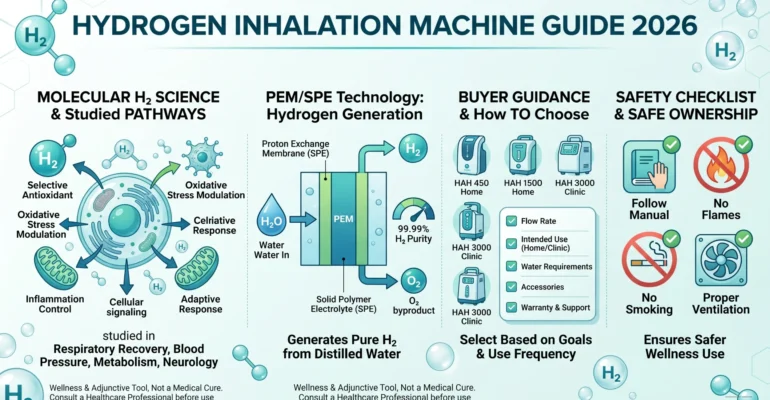
Hydrogen Inhalation Machine Guide 2026
Written by clinical researcher, Dr. Aamir Sohail P.hD in biochemistry and molecular biology: aamir.sohail@oncofit.in.
Introduction
A hydrogen inhalation machine is becoming one of the most searched wellness technologies for people who want to understand molecular hydrogen, oxidative stress, recovery, and safe daily use. Many buyers are interested, but they also have serious questions. Does hydrogen inhalation actually have research behind it? Is it safe? What is PEM/SPE technology? Which device is suitable for home use, clinic use, or wellness support? This guide explains the science in simple language and helps readers make a safer, better-informed decision before choosing a hydrogen inhalation device from Health and Hydrogen.
https://healthandhydrogen.com/
Quick Answer
A hydrogen inhalation machine produces molecular hydrogen gas for breathing through a nasal cannula or mask. Research suggests molecular hydrogen may support antioxidant, anti-inflammatory, respiratory, metabolic, and recovery pathways, but it should not be treated as a cure for disease. The best choice depends on flow rate, PEM/SPE technology, safety features, intended use, and product support. Users with medical conditions should consult a qualified healthcare professional first.
Key Takeaways
- A hydrogen inhalation machine delivers molecular hydrogen, usually through a nasal cannula.
- Human studies are growing, but the evidence is still developing and should be interpreted carefully.
- Molecular hydrogen is studied for oxidative stress, inflammation, recovery, metabolism, respiratory function, and neurological support.
- PEM/SPE electrolysis is important because gas purity and device quality matter.
- Hydrogen is flammable, so users must follow the manual, avoid flames, avoid smoking, and use the device in a suitable environment.
- Health and Hydrogen offers machines for different needs, including HAH 3000, HAH 1800, HAH 900, HAH 450, accessories, videos, and support.
- Hydrogen inhalation should be used as a wellness or adjunctive support tool, not as a replacement for medical care.
What Is a Hydrogen Inhalation Machine?
A hydrogen inhalation machine is a device that generates molecular hydrogen, written as H2, for inhalation. In simple terms, it separates water into gas components using electrolysis, then delivers the gas through accessories such as a nasal cannula. On the Health and Hydrogen homepage, the brand describes its devices as using PEM, or Proton Exchange Membrane, technology and positions them for wellness centers, clinics, and home environments seeking molecular hydrogen tools.
https://healthandhydrogen.com/
The reason people are interested in hydrogen inhalation is that molecular hydrogen is extremely small and can diffuse through biological tissues. A major 2023 review in Molecules reported that hydrogen has been studied across 81 identified clinical trials and 64 human-study publications, with research interest across cardiovascular, respiratory, cancer, central nervous system, infection, and lifestyle-related areas. This does not prove that hydrogen treats these conditions, but it shows why the topic is being investigated seriously.
https://pmc.ncbi.nlm.nih.gov/articles/PMC10707987/
Why Does Molecular Hydrogen Matter?
Molecular hydrogen is often described as a selective antioxidant and signaling modulator. The basic idea is that hydrogen may interact with harmful oxidative stress pathways without acting like a broad antioxidant that blocks every reactive oxygen species. The 2023 Molecules review explains that H2 has been studied for its ability to selectively counteract harmful reactive oxygen species such as hydroxyl radicals, while still leaving normal redox signaling active.
https://pmc.ncbi.nlm.nih.gov/articles/PMC10707987/
This matters because oxidative stress and inflammation are involved in many areas of health, including recovery, cardiovascular strain, respiratory stress, exercise fatigue, and tissue injury. However, the science should be presented carefully. A hydrogen inhalation machine should not be marketed as a cure. A responsible explanation is that molecular hydrogen is being studied as a possible supportive tool for wellness and as an adjunct in clinical research settings.
https://pubmed.ncbi.nlm.nih.gov/24769081/
Hydrogen Inhalation Machine Research: What Does the Evidence Say?
The strongest way to understand hydrogen inhalation is to look at different research areas separately. A large review is useful for seeing the overall landscape, but individual trials help explain what has actually been tested. The current evidence includes randomized studies, observational studies, pilot safety trials, and case reports. These study types are not equal in strength, so buyers should avoid overinterpreting early findings.
https://pmc.ncbi.nlm.nih.gov/articles/PMC10707987/
Respiratory Recovery and Post-Viral Rehabilitation
One important human study examined molecular hydrogen inhalation in acute post-COVID-19 patients. The study reported that 14 days of hydrogen inhalation was associated with improvements in physical and respiratory function, including walking distance and respiratory markers. This is relevant for wellness readers because it connects hydrogen inhalation with recovery and breathing function, but it should not be interpreted as proof that hydrogen inhalation treats viral disease.
https://pmc.ncbi.nlm.nih.gov/articles/PMC8872486/
Blood Pressure and Cardiometabolic Research
A randomized placebo-controlled trial in midlife and older adults with hypertension tested a low-dose hydrogen-oxygen mixture. The study included participants aged 50 to 70 and reported favorable effects on blood pressure and some hormones linked with blood pressure regulation. This is promising for cardiometabolic research, but people with hypertension should never replace prescribed medication or medical monitoring with hydrogen inhalation.
https://www.frontiersin.org/journals/pharmacology/articles/10.3389/fphar.2022.1025487/full
A real-world study in Chinese patients with type 2 diabetes also evaluated hydrogen inhalation as an adjunct to standard care. The authors reported improvements in glycemic control, lipid profile, and insulin resistance in a real-world setting. Because this was not the same as a tightly controlled randomized trial, it is best described as supportive and hypothesis-generating rather than final proof.
https://pmc.ncbi.nlm.nih.gov/articles/PMC10329830/
Metabolism, Fat Oxidation, and Exercise Recovery
A 2025 randomized, double-blind, placebo-controlled crossover study tested 60 minutes of molecular hydrogen inhalation in healthy physically active females. The study found that hydrogen inhalation significantly decreased respiratory exchange ratio compared with placebo, which the authors interpreted as increased resting fat oxidation, especially in participants with higher body fat percentages. This is interesting for metabolism and recovery discussions, but it does not mean a hydrogen inhalation machine is a weight-loss device.
https://pubmed.ncbi.nlm.nih.gov/39923133/
For buyers, the practical meaning is simple. Hydrogen inhalation may be relevant to people interested in recovery, metabolic flexibility, or performance routines, but it should be combined with basics such as sleep, nutrition, movement, hydration, and medical guidance when needed. Health and Hydrogen’s product collection can be explored here for users comparing device options: https://healthandhydrogen.com/shop.
Neurological and Perioperative Research
A randomized controlled study in glioma surgery patients reported that hydrogen/oxygen inhalation reduced postoperative brain edema compared with control oxygen inhalation and improved some short-term recovery-related indicators such as sleep duration and pain scores. This is a clinical research setting, not a home wellness claim. It shows why hydrogen is being studied in nervous system and tissue-protection contexts, but it does not mean people should self-treat neurological conditions.
https://www.frontiersin.org/journals/neurology/articles/10.3389/fneur.2024.1413904/full
A separate case report described hydrogen inhalation in a child with persistent vegetative state after intracerebral hemorrhage. Case reports can be scientifically interesting, but they cannot prove cause and effect. They are best used to guide future research, not to make strong customer promises.
https://www.wjgnet.com/2307-8960/full/v10/i4/1311.htm
Cancer Care Research and Safety Signals
A 2024 pilot feasibility and safety study tested hydrogen gas inhalation during concurrent chemoradiotherapy in 10 patients with locally advanced head and neck cancer. All patients completed 33 hydrogen inhalation sessions, vital signs were stable, and no hydrogen-related adverse events such as cough, nasal bleeding, dizziness, headache, nausea, or vomiting were reported. This is encouraging for feasibility and safety research, but the study was small and not designed to prove cancer treatment efficacy.
https://www.dovepress.com/pilot-feasibility-and-safety-study-of-hydrogen-gas-inhalation-in-local-peer-reviewed-fulltext-article-OTT
Is a Hydrogen Inhalation Machine Safe?
Safety is one of the most important topics for any hydrogen inhalation machine. Human studies generally report good tolerability, and a 2023 review found very few adverse reactions across clinical hydrogen studies. At the same time, hydrogen is flammable, and the review specifically highlights administration challenges related to hydrogen’s low water solubility and explosive properties when mixed with oxygen. This means safe device design, user training, ventilation, and manual compliance matter.
https://pmc.ncbi.nlm.nih.gov/articles/PMC10707987/
A safety study in healthy adults reported that inhalation of 2.4% hydrogen gas for up to 72 hours did not appear to cause clinically significant adverse effects. This is helpful safety information, but it does not remove the need for product-specific instructions, correct setup, and caution in people with medical conditions.
https://pmc.ncbi.nlm.nih.gov/articles/PMC8505337/
Health and Hydrogen’s HAH 3000 operating manual includes practical safety precautions such as keeping the device away from fire, prohibiting smoking during use, keeping open flames away, maintaining space around the machine, using the correct voltage, and turning off or unplugging the device before cleaning or maintenance. These are not optional details. They are part of safe ownership.
https://healthandhydrogen.com/wp-content/uploads/HAH-3000-Operating-Manual-Updated-2024.pdf
How to Choose the Best Hydrogen Inhalation Machine
The best hydrogen inhalation machine depends on who will use it, how often it will be used, and whether it is for home wellness, clinic sessions, or higher-throughput environments. The main factors are flow rate, hydrogen output, oxygen output, PEM/SPE technology, water requirements, accessories, warranty and support, cleaning requirements, and whether the user can follow safety instructions consistently.
For high-output use, the HAH 3000 is listed as a hydrogen inhaler with three flow settings: 3000, 2000, and 1000 ml/min. The product page lists corresponding hydrogen outputs of 2000, 1333, and 667 ml/min, with oxygen outputs of 1000, 667, and 333 ml/min. It also lists 99.99% hydrogen purity, distilled water requirement, and AC110V or AC220V power input.
https://healthandhydrogen.com/hah-3000/
For a mid-range option, the HAH 1800 product page describes the unit as a 1.8L hydrogen inhaler with adjustable flow rates of 900, 1200, and 1800 ml/min. The page also lists SPE and PEM technology, double distilled or pure water requirements, hydrogen inhalation function, and the ability to produce H2 water with a hydrogen rod.
https://healthandhydrogen.com/hah-1800/
For smaller setups, HAH 900 and HAH 450 may be more suitable. The HAH 900 product page lists a 900 ml hydrogen inhaler with 600 ml/min H2 output and 300 ml/min O2 output. The HAH 450 product page lists a 450 ml hydrogen inhaler with 300 ml/min H2 output and 150 ml/min O2 output. These may be more practical for users who want a lower-output device, but buyers should compare features carefully before ordering.
https://healthandhydrogen.com/hah-900/
https://healthandhydrogen.com/hah-450/
Health and Hydrogen also offers hydrogen water products such as the HAH-HM350 Hydro Magic Intelligent Hydrogen Water Bottle. Its product page lists a 280 to 350 ml bottle capacity, 2000 to 9000 PPb hydrogen level, Type C charging, and platinum titanium electrode material. Hydrogen water is a different delivery format from inhalation, so customers should choose based on lifestyle, goals, and product suitability.
https://healthandhydrogen.com/hah-hm350/
What Accessories and Support Should Buyers Consider?
Accessories matter because hydrogen inhalation depends on correct delivery and comfortable use. Health and Hydrogen lists accessories such as nasal cannulas, hydrogen steamer masks, hydrogen infusion rods, eye masks, ear plugs, nose accessories, bubbler cups, and Y connectors. Buyers should only use compatible accessories and should contact support before combining parts in ways not described in the manual.
https://healthandhydrogen.com/accessories-for-hydrogen-inhalation-machines/
Health and Hydrogen also provides supporting videos, including getting started with HAH 3000, cleaning and replacing water, testing output, making hydrogen water, and setup videos for HAH 1800 and HAH 450. This is important for AEO and buyer confidence because many customers want to see exactly how a device is used before purchasing.
https://healthandhydrogen.com/video-session/
https://healthandhydrogen.com/video/
Who Is a Hydrogen Inhalation Machine For?
A hydrogen inhalation machine may be considered by wellness users, clinics, recovery centers, biohacking customers, athletes, and people interested in oxidative stress and general resilience. It may also interest health professionals who want a non-pharmacologic adjunctive wellness tool for structured sessions. However, it is not suitable for careless use, and it should not be promoted as a cure for cancer, diabetes, hypertension, COVID-19, neurological disease, or any other medical condition.
People with diagnosed disease, pregnancy, implanted medical devices, oxygen therapy needs, respiratory illness, heart conditions, cancer treatment, neurological conditions, or prescription medication use should consult a qualified healthcare professional before using hydrogen inhalation. For product-specific questions, buyers can contact Health and Hydrogen support or visit the FAQ page.
https://healthandhydrogen.com/support/
https://healthandhydrogen.com/faqs/
https://healthandhydrogen.com/contact/
FAQs
1. What is a hydrogen inhalation machine?
A hydrogen inhalation machine is a device that generates molecular hydrogen gas for breathing through a nasal cannula or mask. It is used by some wellness users and clinics as a supportive hydrogen delivery method.
2. Does hydrogen inhalation cure disease?
No. Hydrogen inhalation should not be presented as a cure. Research is promising in several areas, but many findings are early, small, or adjunctive. It should be used responsibly and with medical guidance where needed.
3. Is hydrogen inhalation safe?
Human studies generally report good tolerability, but safety depends on correct device use. Hydrogen is flammable, so users must avoid smoking, open flames, heat sources, poor ventilation, and improper maintenance.
4. What does PEM/SPE mean?
PEM means Proton Exchange Membrane, and SPE means Solid Polymer Electrolyte. In hydrogen devices, these technologies are used to help generate hydrogen through electrolysis. Device quality and purity matter for inhalation.
5. Which Health and Hydrogen machine is best for clinics?
The HAH 3000 may be suitable for higher-output use because it offers 3000, 2000, and 1000 ml/min flow settings. Clinics should compare usage volume, room setup, maintenance, accessories, and training needs before choosing.
6. Which machine is better for home use?
Some home users may prefer HAH 1800, HAH 900, or HAH 450 depending on budget, space, flow preference, and support needs. The best choice depends on the user’s goals and ability to follow safety instructions.
7. Can I use hydrogen inhalation with my current medical treatment?
Do not change or stop any treatment without your clinician. Hydrogen inhalation may be discussed as an adjunctive wellness tool, but people with medical conditions should consult a qualified healthcare professional first.
8. Is hydrogen water the same as hydrogen inhalation?
No. Hydrogen water and hydrogen inhalation are different delivery methods. Hydrogen water is consumed, while inhalation delivers gas through breathing accessories. Each has different practical advantages and limitations.
9. How long should a hydrogen inhalation session last?
Research studies have used different session lengths, from shorter sessions to longer protocols. Customers should follow the product manual, start conservatively, and ask Health and Hydrogen support or a healthcare professional for product-specific guidance.
10. Where can I buy a hydrogen inhalation machine?
You can explore Health and Hydrogen products through the main shop and product pages, including HAH 3000, HAH 1800, HAH 900, HAH 450, hydrogen water products, and accessories.
https://healthandhydrogen.com/shop
Conclusion
A hydrogen inhalation machine is a serious wellness technology that deserves a balanced explanation. The research around molecular hydrogen is growing, with studies exploring oxidative stress, inflammation, respiratory recovery, metabolism, cardiometabolic health, neurological support, and safety. The evidence is encouraging, but it is not a reason to make exaggerated medical claims. The safest approach is to choose a quality PEM/SPE device, follow the manual, avoid fire and smoking, use proper water, maintain the machine correctly, and consult a healthcare professional if you have medical concerns.
For customers comparing options, Health and Hydrogen provides several device levels, including HAH 3000 for higher-output use, HAH 1800 for versatile mid-range use, HAH 900 and HAH 450 for smaller setups, hydrogen water products, accessories, support resources, FAQs, and video guidance. This makes it easier to move from curiosity to an informed and safer buying decision.
Explore Health and Hydrogen’s hydrogen inhalation machines, accessories, support videos, and product guidance here: https://healthandhydrogen.com/shop