Hydrogen Inhalation Machine: Evidence, Safety, and Buyer Guide
May 14, 2026 2026-05-14 8:33Hydrogen Inhalation Machine: Evidence, Safety, and Buyer Guide
Hydrogen Inhalation Machine: Evidence, Safety, and Buyer Guide
Written by clinical researcher, Dr. Aamir Sohail, PhD in Biochemistry and Molecular Biology: aamir.sohail@oncofit.in.
A hydrogen inhalation machine is becoming one of the most searched wellness technologies for people interested in molecular hydrogen, oxidative stress, inflammation, recovery, and healthy ageing. Many buyers ask the same important questions before choosing a hydrogen inhalation device: What does the research actually say? Is hydrogen inhalation safe? Which machine type should I choose? Can hydrogen inhalation replace medical treatment? The careful answer is that molecular hydrogen is an active area of clinical research, but it should be understood as a supportive wellness technology, not a cure or substitute for medical care.
Table of Contents
ToggleQuick Answer
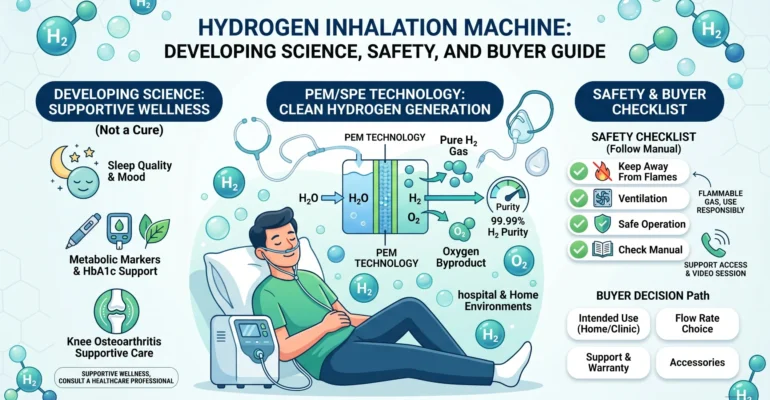
A hydrogen inhalation machine produces molecular hydrogen gas for inhalation, usually through water electrolysis technology such as PEM or SPE. Current human studies suggest possible supportive effects in areas such as sleep quality, blood pressure, type 2 diabetes markers, knee osteoarthritis symptoms, and quality of life in some oncology research. However, evidence is still developing, and hydrogen inhalation should not be presented as a treatment or cure for disease. Users with medical conditions should speak with a qualified healthcare professional first.
Key Takeaways
- Molecular hydrogen is being studied for antioxidant, anti-inflammatory, and cell-signalling effects.
- Human evidence exists, but study quality, design, dosage, and outcomes vary.
- Hydrogen inhalation should be used responsibly as a supportive wellness tool, not as a replacement for medical care.
- Safety depends on correct device design, ventilation, water quality, oxygen balance, and following the product manual.
- PEM and SPE technology are commonly discussed for cleaner hydrogen generation.
- Health and Hydrogen offers hydrogen inhalation machines, hydrogen water products, accessories, support, FAQs, and video sessions.
- Product choice should depend on intended use, flow rate, support needs, budget, and whether the device will be used at home or in a clinic.
What Is a Hydrogen Inhalation Machine?
A hydrogen inhalation machine is a device that generates molecular hydrogen, also written as H2, and delivers it through a nasal cannula or compatible accessory. The basic purpose is to allow a user to inhale hydrogen in a controlled way. Health and Hydrogen describes its devices as using advanced PEM technology for high-purity hydrogen gas delivery and positions them for home, clinic, and wellness environments.
https://healthandhydrogen.com/
Hydrogen is the smallest molecule, and researchers study it because it can diffuse rapidly and may influence oxidative stress, inflammation, apoptosis, mitochondrial function, and cellular signalling. A 2023 review on molecular hydrogen therapy identified 81 clinical trials and 64 human scientific publications, showing that this is no longer only a fringe topic, although many applications still need stronger trials before firm medical conclusions can be made.
https://www.mdpi.com/1420-3049/28/23/7785
Why PEM and SPE Technology Matter
For buyers, technology matters because inhalation requires clean gas delivery. Health and Hydrogen states that polyelectrolyte technology, also known as PEM Proton Exchange Membrane technology, is used in its inhalation devices and is presented as appropriate for frequently inhaled hydrogen in hospital and home settings.
https://healthandhydrogen.com/
Health and Hydrogen product pages list HAH 3000, HAH 1800, HAH 900, and HAH 450 devices, along with the Hydro Magic Intelligent Hydrogen Water Bottle. The HAH 3000 page lists adjustable total flow options of 3000, 2000, and 1000 ml/min, with hydrogen outputs of 2000, 1333, and 667 ml/min and oxygen outputs of 1000, 667, and 333 ml/min. It also lists 99.99% hydrogen purity and distilled water requirement.
https://healthandhydrogen.com/hah-3000/
The HAH 1800 page lists adjustable flow rates of 900, 1200, and 1800/min, SPE and PEM technology, hydrogen inhalation function, and the ability to produce H2 water with a hydrogen rod. The HAH 900 page lists H2 output of 600 ml/min and O2 output of 300 ml/min, while HAH 450 lists H2 output of 300 ml/min and O2 output of 150 ml/min.
https://healthandhydrogen.com/hah-1800/
https://healthandhydrogen.com/hah-900/
https://healthandhydrogen.com/hah-450/
What Does the Science Say About Hydrogen Inhalation?
The strongest way to understand hydrogen inhalation is to look at the research cautiously. The studies attached for this article include real-world diabetes research, a sleep trial, a hypertension trial, a knee osteoarthritis trial, oncology review evidence, and ovarian cancer preclinical research. These studies do not prove that every person will benefit, and they do not justify disease-cure claims. They do show why molecular hydrogen continues to attract clinical and wellness interest.
Type 2 Diabetes: Real-World Evidence
A 2023 retrospective, multicentre, observational study followed 431 Chinese patients with type 2 diabetes who used hydrogen inhalation as a supplementary therapy for six months. The study reported reductions in HbA1c, fasting plasma glucose, body weight, and insulin dose. HbA1c changed from 9.04% at baseline to 8.30% at 3 months and 8.00% at 6 months. The authors also noted that people with higher baseline HbA1c and longer daily inhalation time had greater HbA1c reductions. The most common adverse event was hypoglycaemia, which is especially important for people using glucose-lowering medication.
https://doi.org/10.2147/DMSO.S412898
This does not mean a hydrogen inhalation machine treats diabetes. The study was single-arm and retrospective, so it cannot prove the same level of causation as a well-controlled randomized clinical trial. For ecommerce education, the correct message is that hydrogen inhalation is being studied as a supplementary approach for metabolic health, but people with diabetes must not change medication, insulin, diet, or monitoring without medical supervision.
https://doi.org/10.2147/DMSO.S412898
Sleep Quality and Mood: Early Clinical Trial Evidence
A single-blind randomized controlled trial examined hydrogen-oxygen inhalation in 66 participants with sleep disorders over seven days. The hydrogen-oxygen group showed improvements in total sleep time and sleep efficiency on days 3, 5, and 7, along with reduced wake time on days 3 and 7. After seven days, Pittsburgh Sleep Quality Index and Self-Rating Depression Scale scores were lower than the control group, while anxiety scores did not differ significantly between groups.
https://doi.org/10.4103/mgr.MEDGASRES-D-25-00020
This is promising for people researching hydrogen inhalation for sleep support, but the study was short and had a limited sample size. The authors also stated that low-dose hydrogen-oxygen inhalation for sleep disorders is still at the clinical trial stage and that mechanisms require further confirmation. A responsible buyer should view this as emerging evidence, not proof that hydrogen inhalation cures insomnia.
https://doi.org/10.4103/mgr.MEDGASRES-D-25-00020
Blood Pressure and Cardiovascular Research
A randomized, placebo-controlled trial tested low-dose hydrogen-oxygen mixture inhalation in adults aged 50 to 70 with hypertension. Participants used either placebo air or a 66% H2 and 33% O2 mixture for four hours per day over two weeks. Among 56 completers, the H2-O2 group showed significant reductions in right and left arm systolic blood pressure compared with baseline, and a reduction in nighttime ambulatory diastolic blood pressure. The study also reported lower angiotensin II, aldosterone, cortisol, and aldosterone-to-renin ratio after the intervention.
https://doi.org/10.3389/fphar.2022.1025487
The authors suggested a favourable effect on blood pressure and hormone markers related to the renin-angiotensin-aldosterone system and stress, but the trial was small and short. People with hypertension should not use hydrogen inhalation as a replacement for prescribed medication, monitoring, exercise, diet, or professional cardiovascular care.
https://doi.org/10.3389/fphar.2022.1025487
Knee Osteoarthritis and Mobility
A 2025 randomized controlled trial studied hydrogen-oxygen mixture inhalation as an adjunct to a 12-week home-based exercise program in older patients with knee osteoarthritis. The hydrogen group received H2-O2 inhalation for 60 minutes per day over two weeks, while both groups completed exercise and health education. The study included 121 subjects with an average age of 81.2 years. Both groups improved, but the between-group difference in total WOMAC score at week 12 was not statistically significant.
https://doi.org/10.3389/fphar.2025.1505922
The important buyer lesson is balance. The study concluded that H2-O2 inhalation helped symptoms and functional activity during the initial two weeks, but sustained clinical significance at 12 weeks was not shown. Adverse events were not significantly different between groups, with the hydrogen group reporting headache and nasal dryness in a small number of cases.
https://doi.org/10.3389/fphar.2025.1505922
Oncology Research: Interesting but Not a Cure Claim
The oncology evidence needs the most careful wording. A narrative review discussed hydrogen oncology and reported a real-world survey of 82 advanced cancer patients who inhaled hydrogen at home or rehabilitation centres. The authors reported quality-of-life improvements after four weeks, with the most notable changes in fatigue, insomnia, appetite loss, and pain. Imaging response data included complete response in 1.3%, partial response in 18.8%, stable disease in 37.5%, and progressive disease in 42.5%, with no hematological toxicity observed.
https://doi.org/10.4103/2045-9912.296044
This evidence should be treated cautiously because real-world surveys and case reports cannot replace controlled oncology trials. Hydrogen inhalation should never be promoted as a cancer cure or as an alternative to oncology treatment. The reasonable interpretation is that hydrogen is being investigated for possible supportive roles in quality of life, symptom burden, immune function, and treatment tolerance, but patients must discuss any use with their oncology team.
https://doi.org/10.4103/2045-9912.296044
A separate ovarian cancer study used cell models and mice. Six weeks of hydrogen inhalation significantly reduced mean tumour volume in a xenograft mouse model and reduced markers such as Ki67 and CD34. In vitro, hydrogen treatment inhibited cancer cell proliferation, invasion, migration, colony formation, and sphere-forming ability. This is mechanistically interesting, but it is preclinical research and cannot be translated into a human treatment claim.
http://dx.doi.org/10.21037/tcr.2018.07.09
Is Hydrogen Inhalation Safe?
Molecular hydrogen itself is generally discussed as having a low biological toxicity profile. The Molecular Hydrogen Institute states that molecular hydrogen is generally considered safe when used as directed, while also warning that hydrogen gas is flammable between 4% and 75% concentration by volume and that equipment choice matters.
https://molecularhydrogeninstitute.org/is-molecular-hydrogen-safe/
Hydrogen safety is not only about the molecule. It is also about the machine, room ventilation, oxygen balance, ignition sources, water quality, electrical safety, tubing, cleaning, and user behaviour. The International Chemical Safety Card for hydrogen describes hydrogen as an extremely flammable gas and notes explosive limits of 4% to 75% in air. The U.S. Department of Energy also notes that hydrogen is colourless, odourless, diffuses rapidly, and requires appropriate safety awareness.
https://inchem.org/documents/icsc/icsc/eics0001.htm
https://www1.eere.energy.gov/hydrogenandfuelcells/pdfs/h2_safety_fsheet.pdf
For home users, practical safety means using the device only according to the manual, keeping the area ventilated, avoiding smoking or open flames near the device, using recommended water, replacing accessories as instructed, and contacting support if there is unusual sound, smell, heat, leakage, alarm, or performance issue. People with lung disease, heart disease, cancer, diabetes, pregnancy, implanted medical devices, oxygen therapy, or complex medication plans should consult a qualified healthcare professional before use.
How to Choose a Hydrogen Inhalation Machine
The best hydrogen inhalation machine is not simply the highest-flow device. A clinic may need a higher-capacity model, while a home user may prefer a smaller device with simple operation, support, and clear maintenance instructions. Buyers should compare flow rate, hydrogen output, oxygen output, hydrogen purity, technology type, water requirements, weight, support access, warranty, accessories, and product documentation.
Health and Hydrogen’s shop lists hydrogen inhalation machines, the Hydro Magic Bottle, and accessories such as nasal cannulas, bubbler cups, masks, eye masks, ear plugs, and hydrogen therapy accessories. The homepage also highlights one-on-one support sessions for setup, troubleshooting, and learning how to use a device correctly.
https://healthandhydrogen.com/shop
https://healthandhydrogen.com/video-session/
For product comparison, start with the main shop page, then review the HAH 450, HAH 900, HAH 1800, and HAH 3000 pages. For setup questions, visit the support page or contact page. For common buyer questions, the FAQ page is the right next step.
https://healthandhydrogen.com/shop
https://healthandhydrogen.com/support/
https://healthandhydrogen.com/faqs/
https://healthandhydrogen.com/contact/
FAQs About Hydrogen Inhalation Machines
1. What is a hydrogen inhalation machine used for?
A hydrogen inhalation machine is used to generate molecular hydrogen gas for inhalation. People usually explore it for wellness, recovery, oxidative stress support, healthy ageing, sleep support, and general health interest. It should not be used to diagnose, treat, cure, or prevent disease.
2. Is hydrogen inhalation the same as oxygen therapy?
No. Oxygen therapy provides medical oxygen and is used under medical guidance for oxygen-related conditions. Hydrogen inhalation delivers molecular hydrogen, often with oxygen depending on the device design. Do not replace prescribed oxygen therapy with hydrogen inhalation.
3. What does hydrogen do in the body?
Research suggests molecular hydrogen may influence oxidative stress, inflammation, apoptosis, mitochondrial function, and cell signalling. However, mechanisms are still being studied, and benefits may vary based on dose, delivery method, user health status, and study design.
4. Can a hydrogen inhalation machine help with sleep?
A small randomized trial reported improvements in total sleep time, wake time, sleep quality scores, and depression scores after seven days of hydrogen-oxygen inhalation. This is early evidence and should not be treated as proof that hydrogen inhalation cures insomnia.
https://doi.org/10.4103/mgr.MEDGASRES-D-25-00020
5. Can people with diabetes use hydrogen inhalation?
People with diabetes should speak with a qualified healthcare professional before use. A real-world study reported improved HbA1c and fasting glucose markers, but hypoglycaemia was the most common adverse event, which matters for users taking insulin or glucose-lowering medication.
https://doi.org/10.2147/DMSO.S412898
6. Is hydrogen inhalation safe at home?
Hydrogen can be used safely only when the device is properly designed and used correctly. Because hydrogen is flammable in certain air concentrations, users should follow the manual, use ventilation, keep away from flames, and contact support for product-specific questions.
https://inchem.org/documents/icsc/icsc/eics0001.htm
7. What is better, hydrogen inhalation or hydrogen water?
They are different delivery methods. Hydrogen inhalation delivers gas through breathing, while hydrogen water delivers dissolved H2 through drinking water. The better option depends on the user’s purpose, lifestyle, budget, tolerance, and professional advice.
8. What flow rate should I choose?
Flow rate depends on whether the device is for personal home use, clinic use, wellness centre use, or shared use. Higher flow is not automatically better for every buyer. Compare product pages, manuals, and support guidance before choosing.
9. Can hydrogen inhalation replace medical treatment?
No. Hydrogen inhalation should not replace medication, surgery, oxygen therapy, cancer treatment, diabetes care, blood pressure medication, sleep therapy, or any prescribed treatment. It is best understood as a supportive wellness technology.
10. Where can I buy Health and Hydrogen products?
You can compare products on the Health and Hydrogen shop and individual device pages, including HAH 3000, HAH 1800, HAH 900, HAH 450, and Hydro Magic Bottle.
https://healthandhydrogen.com/shop
Conclusion
A hydrogen inhalation machine is a promising wellness technology supported by a growing body of molecular hydrogen research. The strongest evidence at present is not that hydrogen inhalation cures disease, but that it is being actively studied for supportive roles in oxidative stress, inflammation, sleep quality, metabolic markers, blood pressure, joint comfort, and quality of life. The safest and most trustworthy approach is to choose a well-documented device, follow the manual, use proper ventilation, understand the limitations of the science, and consult a healthcare professional if you have a medical condition.
Health and Hydrogen helps buyers explore hydrogen inhalation machines, hydrogen water products, accessories, support resources, FAQs, and video setup guidance in one place. For a careful next step, compare the product range, read the support pages, and contact the team with product-specific questions before choosing your device.
Explore Health and Hydrogen products and support here:
https://healthandhydrogen.com/shop
https://healthandhydrogen.com/support/
https://healthandhydrogen.com/contact/
Search
Categories
- ANI NEWS (1)
- AP NEWS (1)
- Applications (26)
- Beauty Clinics (1)
- BENZINGA ESPANA (1)
- BOLSAMANIA (1)
- Brain cancer (14,615)
- Breast Cancer (12,744)
- Cervical Cancer (11,502)
- Cision (1)
- Colon Cancer (11,405)
- EUROPA PRESS (1)
- FINANZEN (1)
- Genetic and Congenital Disorders (195)
- Hydrogen Inhalation Machine (15,420)
- Hydrogen Inhalation Therapy (11,414)
- Infectious Diseases (242)
- Lung Cancer (11,505)
- News (8)
- Non Alcoholic Fatty Liver (11,504)
- Ovarian Cancer (11,506)
- Oxidative Stress (2)
- Pancreatic cancer (11,505)
- Parkinson's disease (10,167)
- Post Covid (11,504)
- PR Newswire (1)
- Press Release (13)
- Seeking Alpha (1)
- The Print (1)
- The Times of India (1)
- Uncategorized (9)
- WALLSTREET ONLINE (1)
- ZEE 5 (1)