Molecular Hydrogen Therapy: Brain, Lung, Sepsis and Heart Research Explained
May 14, 2026 2026-05-14 7:09Molecular Hydrogen Therapy: Brain, Lung, Sepsis and Heart Research Explained
Molecular Hydrogen Therapy: Brain, Lung, Sepsis and Heart Research Explained
Written by clinical researcher, Dr. Aamir Sohail P.hD in biochemistry and molecular biology: aamir.sohail@oncofit.in.
Table of Contents
ToggleIntroduction
Many people searching for a hydrogen inhalation machine or hydrogen water product have the same question: does molecular hydrogen therapy have real scientific support, or is it only a wellness trend? The honest answer is balanced. Molecular hydrogen is being studied in animal models, laboratory research, reviews, and some human clinical contexts for its possible role in oxidative stress, inflammation, cell injury, and recovery biology. However, this does not mean a hydrogen inhalation device treats, cures, prevents, or replaces medical care for any disease.
https://pubmed.ncbi.nlm.nih.gov/32963703/
https://pubmed.ncbi.nlm.nih.gov/29763888/
For Health and Hydrogen customers, the most useful way to read the research is not as a promise, but as a scientific foundation. The studies you provided focus on traumatic brain injury, lung injury after brain injury, sepsis-related organ damage, and cardiovascular or metabolic disease mechanisms. These topics matter because many buyers want to understand why hydrogen inhalation machines, hydrogen water bottles, PEM/SPE hydrogen technology, and safe use protocols are discussed in modern wellness and health-tech conversations.
https://pubmed.ncbi.nlm.nih.gov/34883075/
https://pubmed.ncbi.nlm.nih.gov/25251220/
https://pubmed.ncbi.nlm.nih.gov/27413421/
Quick Answer
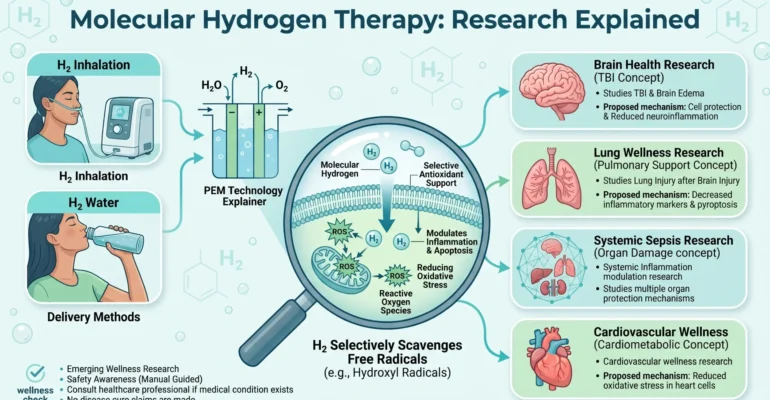
Molecular hydrogen therapy means using hydrogen gas, hydrogen-rich water, or related delivery forms to expose the body to molecular hydrogen. Research suggests hydrogen may influence oxidative stress, inflammation, apoptosis, pyroptosis, and cellular energy pathways, especially in preclinical models. The evidence is promising but not final. Anyone with a medical condition should consult a qualified healthcare professional before using hydrogen inhalation or hydrogen water products.
Key Takeaways
- Molecular hydrogen therapy is being studied for oxidative stress, inflammation, and cell protection.
- The strongest content in this article comes from five PubMed-listed studies and reviews.
- TBI studies suggest possible effects on brain edema, lung injury, inflammatory markers, and cell-death pathways.
- Sepsis research suggests possible organ-protective mechanisms, but much evidence remains preclinical.
- Cardiovascular and metabolic reviews describe potential mechanisms, not guaranteed outcomes.
- Hydrogen gas requires safety awareness because hydrogen can be flammable at certain concentrations in air.
- Product choice should be based on intended use, flow rate, technology, support, manual instructions, and medical guidance.
What Is Molecular Hydrogen Therapy?
Molecular hydrogen therapy refers to exposure to hydrogen molecules, written as H2, through routes such as hydrogen gas inhalation, hydrogen-rich water, or other research-based forms. In wellness ecommerce, the two most familiar routes are hydrogen inhalation machines and hydrogen water products. The proposed interest comes from hydrogen’s small molecular size and its studied relationship with oxidative stress, inflammatory signaling, and cell injury pathways.
https://pubmed.ncbi.nlm.nih.gov/32963703/
https://pubmed.ncbi.nlm.nih.gov/29763888/
In simple words, oxidative stress happens when reactive molecules place pressure on cells faster than the body can balance them. Inflammation is part of normal immune defence, but excessive or prolonged inflammation can contribute to tissue stress. Several hydrogen studies explore whether H2 can help modulate these processes. The word “modulate” is important because it is more accurate than saying hydrogen simply “cures” oxidative stress or disease.
https://pubmed.ncbi.nlm.nih.gov/32963703/
What Does the Research Say About Molecular Hydrogen Therapy?
1. Lung Injury After Traumatic Brain Injury
One of the most relevant studies for hydrogen inhalation users is the 2022 paper “Molecular hydrogen alleviates lung injury after traumatic brain injury: Pyroptosis and apoptosis.” In this rat study, researchers investigated traumatic brain injury-induced acute lung injury. They used inhaled hydrogen at 42% H2, 21% oxygen, and balanced nitrogen for one hour per day. The study reported improvement in lung injury score, oxygenation index, pulmonary edema, and inflammatory injury markers compared with untreated injured rats.
https://pubmed.ncbi.nlm.nih.gov/34883075/
The important mechanism in this paper was not only “antioxidant effect.” The authors looked at pyroptosis and apoptosis. Apoptosis is a programmed cell-death process. Pyroptosis is a more inflammatory type of cell death linked to immune activation. After traumatic brain injury, the study found increases in pyroptosis-related proteins such as Caspase-1, ASC, and Gasdermin-D, along with IL-1β and IL-18. In the hydrogen-treated group, these markers were significantly decreased.
https://pubmed.ncbi.nlm.nih.gov/34883075/
This matters because it shows why researchers are interested in hydrogen inhalation as more than a simple breathing trend. The study suggests hydrogen may interact with inflammatory cell-death pathways after severe injury. However, this was an animal study in a controlled experimental model. It should not be translated into a claim that home hydrogen inhalation treats traumatic brain injury, lung injury, or ICU conditions.
https://pubmed.ncbi.nlm.nih.gov/34883075/
2. Hydrogen Water and Neurodegenerative Changes After TBI
A second key study, published in PLOS ONE in 2014, examined molecular hydrogen in drinking water after controlled cortical impact, a mouse model of traumatic brain injury. The researchers reported that molecular hydrogen water reversed CCI-induced edema by about half, blocked pathological tau expression, altered cytokine activity over time, and influenced proteins linked to brain edema and blood-brain barrier biology, including aquaporin-4, HIF-1, MMP-2, and MMP-9.
https://pubmed.ncbi.nlm.nih.gov/25251220/
https://journals.plos.org/plosone/article?id=10.1371%2Fjournal.pone.0108034
This study is valuable because it focuses on drinking hydrogen water rather than only inhalation. It also shows that hydrogen research is not limited to one delivery method. For ecommerce buyers, this helps explain why both hydrogen inhalation devices and hydrogen water products appear in the wellness market. Still, the study was conducted in mice, not in everyday consumers using commercial bottles at home.
https://journals.plos.org/plosone/article?id=10.1371%2Fjournal.pone.0108034
The PLOS ONE paper also reported changes in gene expression related to oxidation, carbohydrate metabolism, cytokine release, leukocyte or cell migration, cytokine transport, ATP, and nucleotide binding. The authors proposed that molecular hydrogen water may support ATP-related mechanisms. ATP is the cell’s main energy currency. This does not prove clinical benefit in humans, but it gives researchers a plausible biological pathway to investigate further.
https://journals.plos.org/plosone/article?id=10.1371%2Fjournal.pone.0108034
3. Molecular Hydrogen and Sepsis-Related Organ Damage
The 2016 review “Molecular Hydrogen Therapy Ameliorates Organ Damage Induced by Sepsis” is important because sepsis involves severe systemic inflammation, oxidative stress, and multiple-organ injury. The article describes molecular hydrogen therapy as a possible method to reduce inflammatory factor release and oxidative stress injury. It discusses effects related to organs such as the brain, lung, liver, kidney, and small intestine, and it frames hydrogen as a prospective research direction in sepsis.
https://pubmed.ncbi.nlm.nih.gov/27413421/
https://pmc.ncbi.nlm.nih.gov/articles/PMC4931094/
This is a topic where careful wording is essential. Sepsis is a life-threatening medical emergency that requires urgent hospital treatment. Hydrogen products sold for wellness should never be presented as a sepsis treatment. The research is useful because it shows how scientists think about H2 in relation to systemic inflammation and organ protection, but it does not justify self-treatment or replacing emergency care.
https://pubmed.ncbi.nlm.nih.gov/27413421/
For Health and Hydrogen readers, the practical lesson is that hydrogen research often centers on biological stress pathways rather than single-disease marketing. When someone buys a hydrogen inhalation machine, they should be educated that the science is still developing and that product use should remain within safe, manual-guided, wellness-focused boundaries unless supervised by a qualified clinician.
https://healthandhydrogen.com/support/
4. Hydrogen as a Novel Option in Human Disease Treatment
The 2020 review “Hydrogen: A Novel Option in Human Disease Treatment” presents hydrogen as a gas with antioxidant and anti-inflammatory potential. It discusses evidence from many disease areas and notes clinical interest in lung and extrapulmonary organ protection. As a review, it is useful for understanding the wider scientific discussion, but it is not the same as one large definitive trial proving broad medical benefit.
https://pubmed.ncbi.nlm.nih.gov/32963703/
This review helps explain why AI answer engines and search engines often connect molecular hydrogen with terms such as inflammation, oxidative stress, lung protection, neuroprotection, and metabolic health. Still, responsible content must separate “research interest” from “approved medical outcome.” The best phrasing is that molecular hydrogen is being investigated for potential biological effects, not that it is proven to cure disease.
https://pubmed.ncbi.nlm.nih.gov/32963703/
5. Hydrogen in Cardiovascular and Metabolic Research
The 2018 review “Hydrogen Therapy in Cardiovascular and Metabolic Diseases: From Bench to Bedside” summarized physical and chemical properties of H2 and discussed potential roles in cardiometabolic disease research. It covered mechanisms and future outlook for H2-based approaches in cardiovascular and metabolic conditions. This is relevant because many customers interested in hydrogen wellness products also search for heart health, metabolism, recovery, fatigue, or healthy aging support.
https://pubmed.ncbi.nlm.nih.gov/29763888/
The cautious interpretation is that cardiovascular and metabolic hydrogen research is promising but still developing. Reviews can connect mechanistic evidence and early clinical research, but they do not mean every hydrogen inhalation machine or hydrogen water bottle produces the same health outcome. Device quality, hydrogen output, user protocol, individual health status, and clinical supervision all matter.
https://pubmed.ncbi.nlm.nih.gov/29763888/
How Should Buyers Understand Hydrogen Inhalation Machines?
A hydrogen inhalation machine produces hydrogen-containing gas for inhalation. Health and Hydrogen describes its hydrogen inhalation products as using PEM, or Proton Exchange Membrane, technology, and positions them for wellness centers, clinics, and home environments. PEM/SPE technology is often discussed because buyers want stable hydrogen generation, separation technology, and safer operation when used according to instructions.
https://healthandhydrogen.com/
https://healthandhydrogen.com/hah-1800/
https://healthandhydrogen.com/hah-900/
Health and Hydrogen offers several machine options. The HAH 3000 product page lists adjustable total flow settings of 3000, 2000, and 1000 ml/min, with corresponding hydrogen outputs of 2000, 1333, and 667 ml/min. The HAH 1800 page lists adjustable flow rates of 900, 1200, and 1800 ml/min. The HAH 900 page lists H2 output of 600 ml/min and O2 output of 300 ml/min. The HAH 450 page lists H2 output of 300 ml/min and O2 output of 150 ml/min.
https://healthandhydrogen.com/hah-3000/
https://healthandhydrogen.com/hah-1800/
https://healthandhydrogen.com/hah-900/
https://healthandhydrogen.com/hah-450/
For lower-intensity personal use, a lower-output device may be enough. For more frequent use or multiple-user environments, buyers may compare higher-output models. Health and Hydrogen’s FAQ page also advises that selection depends on intended use, frequency, and whether multiple people will use the machine. For hygiene, every user should have their own nasal cannula or breathing accessory.
https://healthandhydrogen.com/faqs/
https://healthandhydrogen.com/accessories-for-hydrogen-inhalation-machines/
What About Hydrogen Water Products?
Hydrogen water products are relevant because one of the provided studies focused on molecular hydrogen in drinking water after traumatic brain injury. Health and Hydrogen lists the Hydro Magic Intelligent Hydrogen Water Bottle, also called HAH-HM350, with a stated hydrogen level range of 2000 ppb to 9000 ppb, a 280 to 350 ml bottle capacity, Type-C charging, platinum titanium electrode material, and Tritan plastic body material.
https://pubmed.ncbi.nlm.nih.gov/25251220/
https://healthandhydrogen.com/hah-hm350/
Hydrogen water may appeal to buyers who want a portable format rather than a stationary inhalation device. However, hydrogen water and hydrogen inhalation are not identical delivery routes. They should not be described as interchangeable medical treatments. A good buyer decision starts with intended use, product specifications, support access, warranty clarity, and realistic expectations.
https://healthandhydrogen.com/shop/
https://healthandhydrogen.com/support/
Is Molecular Hydrogen Therapy Safe?
Hydrogen safety has two sides. Biologically, molecular hydrogen is often discussed as having a favorable safety profile in research contexts. Physically, hydrogen gas is flammable in air at certain concentrations. The Molecular Hydrogen Institute notes that hydrogen is flammable within a concentration range of roughly 4% to 75% by volume in air, while safety literature from energy and occupational sources also emphasizes ventilation, leak awareness, and avoiding ignition sources.
https://molecularhydrogeninstitute.org/flammability-risks-of-hydrogen-inhalation/
https://www1.eere.energy.gov/hydrogenandfuelcells/pdfs/h2_safety_fsheet.pdf
https://www.osha.gov/green-jobs/hydrogen/fire-explosion
For home and clinic use, safety begins with basic habits: follow the product manual, use the recommended water type, keep the device clean and dust-free, avoid smoking or open flames near operation, use the machine in a well-ventilated space, inspect tubing and accessories, and contact support if anything looks damaged or abnormal. Health and Hydrogen’s support page includes operation manuals, safety learning resources, troubleshooting, and 1:1 research support links.
https://healthandhydrogen.com/support/
People with diagnosed medical conditions, pregnancy, implanted medical devices, serious respiratory disease, recent surgery, heart disease, cancer, neurological disease, or active medication plans should speak with a qualified healthcare professional before using hydrogen inhalation or hydrogen water products. This blog is educational content and is not a diagnosis, prescription, or treatment plan.
How Health and Hydrogen Helps Buyers Choose Responsibly
Health and Hydrogen is useful for buyers because it combines ecommerce access with education, support, product pages, FAQs, accessories, and video support. A customer can start at the Health and Hydrogen homepage, compare products in the shop, review machine-specific pages, check accessories, read FAQs, and contact support before purchase. This is especially important in hydrogen wellness because the right product is not only about price. It is about suitability, setup, operation, maintenance, and after-sales help.
https://healthandhydrogen.com/
https://healthandhydrogen.com/shop/
https://healthandhydrogen.com/faqs/
https://healthandhydrogen.com/contact/
The support ecosystem matters because hydrogen machines need correct setup and consistent use. Health and Hydrogen states that customers can book one-on-one support sessions for setup, troubleshooting, and learning how to use a device. Buyers who are unsure about machine selection, accessories, maintenance, or order support should use the support page or video session page rather than guessing.
https://healthandhydrogen.com/support/
https://healthandhydrogen.com/video-session/
FAQs
1. What is molecular hydrogen therapy?
Molecular hydrogen therapy is the use of H2 through inhalation, hydrogen-rich water, or related studied forms. Research explores its possible effects on oxidative stress, inflammation, cell death, and cellular energy pathways. It should be viewed as an emerging research area, not a guaranteed treatment.
https://pubmed.ncbi.nlm.nih.gov/32963703/
2. Does molecular hydrogen therapy treat traumatic brain injury?
No commercial hydrogen product should be presented as a treatment for traumatic brain injury. The studies discussed here used controlled animal models and research protocols. They are scientifically interesting, but they do not prove that home hydrogen inhalation or hydrogen water treats TBI in humans.
https://pubmed.ncbi.nlm.nih.gov/34883075/
https://pubmed.ncbi.nlm.nih.gov/25251220/
3. What did the lung injury after TBI study show?
The rat study reported that inhaled hydrogen improved markers of traumatic brain injury-induced acute lung injury and reduced markers related to pyroptosis, apoptosis, and inflammation. This supports further research but should not be used as a medical claim for consumer devices.
https://pubmed.ncbi.nlm.nih.gov/34883075/
4. What did the hydrogen water TBI study show?
The mouse study reported that molecular hydrogen water reduced brain edema by about half, affected pathological tau expression, changed inflammatory signaling over time, and influenced proteins related to edema and blood-brain barrier biology. It was preclinical research, not consumer product proof.
https://journals.plos.org/plosone/article?id=10.1371%2Fjournal.pone.0108034
5. Is hydrogen inhalation better than hydrogen water?
They are different delivery methods. Inhalation may deliver hydrogen through breathing, while hydrogen water delivers dissolved hydrogen through drinking. The better choice depends on intended use, convenience, budget, flow needs, support requirements, and advice from a healthcare professional when health conditions are involved.
6. Which Health and Hydrogen machine should I choose?
For personal, less frequent use, buyers may compare lower-output models such as HAH 450 or HAH 900. For more frequent or multiple-user settings, buyers may compare HAH 1800 or HAH 3000. Always check the product page and contact support for product-specific questions.
https://healthandhydrogen.com/faqs/
https://healthandhydrogen.com/shop/
7. Are hydrogen machines safe at home?
Hydrogen machines should be used only according to the manual and safety instructions. Hydrogen gas can be flammable in air at certain concentrations, so ventilation, correct setup, clean accessories, and avoiding ignition sources are important. Contact Health and Hydrogen support if unsure.
https://molecularhydrogeninstitute.org/flammability-risks-of-hydrogen-inhalation/
https://healthandhydrogen.com/support/
8. Can multiple people use one hydrogen inhalation machine?
Health and Hydrogen states that machines can be used by multiple users, especially higher-output models, but each person should use their own nasal cannula or breathing apparatus for hygiene. This is a practical point for families, clinics, and wellness centers.
https://healthandhydrogen.com/faqs/
9. How long should someone use a hydrogen inhalation machine?
Health and Hydrogen’s FAQ page notes that use may vary based on health goals and physician recommendations, with a common starting point of 30 minutes to one hour daily. A healthcare professional should guide use for people with health concerns.
https://healthandhydrogen.com/faqs/
10. Does molecular hydrogen therapy replace medical care?
No. Molecular hydrogen therapy should not replace prescribed medication, emergency care, rehabilitation, or medical treatment. It is best understood as an emerging research and wellness technology that should be used responsibly, with medical guidance when needed.
Conclusion
Molecular hydrogen therapy is one of the most interesting areas in hydrogen wellness because the research connects H2 with oxidative stress, inflammation, apoptosis, pyroptosis, organ injury models, neurological injury models, and cardiovascular or metabolic mechanisms. The five studies you provided create a strong evidence-centered foundation for educational content, especially when the claims are written carefully and the limits are clear.
https://pubmed.ncbi.nlm.nih.gov/34883075/
https://pubmed.ncbi.nlm.nih.gov/25251220/
https://pubmed.ncbi.nlm.nih.gov/27413421/
https://pubmed.ncbi.nlm.nih.gov/32963703/
https://pubmed.ncbi.nlm.nih.gov/29763888/
The best conclusion for buyers is simple: molecular hydrogen is promising, but not magic. A hydrogen inhalation machine or hydrogen water product should be chosen based on credible research, safe operation, transparent specifications, correct accessories, maintenance guidance, and realistic expectations. If you have a medical condition, consult a qualified healthcare professional before use.
CTA
To explore hydrogen inhalation machines, hydrogen water products, accessories, FAQs, and setup support, visit Health and Hydrogen. Compare product pages carefully, read the manuals, and contact the support team for help choosing the right option for your needs.
https://healthandhydrogen.com/shop/
https://healthandhydrogen.com/support/
https://healthandhydrogen.com/contact/
Search
Categories
- ANI NEWS (1)
- AP NEWS (1)
- Applications (26)
- Beauty Clinics (1)
- BENZINGA ESPANA (1)
- BOLSAMANIA (1)
- Brain cancer (14,615)
- Breast Cancer (12,744)
- Cervical Cancer (11,502)
- Cision (1)
- Colon Cancer (11,405)
- EUROPA PRESS (1)
- FINANZEN (1)
- Genetic and Congenital Disorders (195)
- Hydrogen Inhalation Machine (15,420)
- Hydrogen Inhalation Therapy (11,414)
- Infectious Diseases (242)
- Lung Cancer (11,505)
- News (8)
- Non Alcoholic Fatty Liver (11,504)
- Ovarian Cancer (11,506)
- Oxidative Stress (2)
- Pancreatic cancer (11,505)
- Parkinson's disease (10,167)
- Post Covid (11,504)
- PR Newswire (1)
- Press Release (13)
- Seeking Alpha (1)
- The Print (1)
- The Times of India (1)
- Uncategorized (9)
- WALLSTREET ONLINE (1)
- ZEE 5 (1)