Molecular Hydrogen Research and Hydrogen Machines
May 14, 2026 2026-05-14 7:25Molecular Hydrogen Research and Hydrogen Machines
Molecular Hydrogen Research and Hydrogen Machines
Written by clinical researcher, Dr. Aamir Sohail P.hD in biochemistry and molecular biology: aamir.sohail@oncofit.in.
Introduction
Many people discover hydrogen inhalation machines or hydrogen water products after reading about oxidative stress, inflammation, brain health, recovery, or cellular wellness. The problem is that online claims can be confusing. Some articles make molecular hydrogen sound like a cure for every condition, while others dismiss it without reviewing the actual research. The balanced answer is more useful: molecular hydrogen research is promising, especially around oxidative stress and inflammation pathways, but it is still developing and should not be treated as proof that a hydrogen machine diagnoses, treats, cures, or prevents disease.
https://pmc.ncbi.nlm.nih.gov/articles/PMC10707987/
https://molecularhydrogeninstitute.org/is-molecular-hydrogen-safe/
For Health and Hydrogen customers, this matters because the goal is not hype. The goal is to understand what the science says, what it does not say, how hydrogen-rich water and hydrogen-rich saline studies relate to inhalation devices, and how to choose a safe hydrogen inhalation machine for daily wellness support. You can explore Health and Hydrogen products through the main shop when you are ready to compare models.
https://healthandhydrogen.com/
https://healthandhydrogen.com/shop
Quick Answer
Molecular hydrogen research suggests that hydrogen may influence oxidative stress, inflammation, apoptosis, autophagy, endoplasmic reticulum stress, gut-brain signaling, and tissue recovery pathways. Studies in pancreatitis, Alzheimer’s disease models, early brain injury, and peripheral nerve repair are promising but mostly preclinical or disease-specific. Hydrogen inhalation machines and hydrogen water products should be viewed as wellness technologies, not medical cures. Always follow product instructions and consult a qualified healthcare professional if you have a medical condition.
Key Takeaways
- Molecular hydrogen research focuses strongly on oxidative stress and inflammation.
- The pancreatitis review links hydrogen effects to antioxidant, anti-inflammatory, anti-apoptotic, immune, and molecular pathway regulation.
- The Alzheimer’s disease study used hydrogen-rich water in a mouse model, not a human clinical trial.
- Hydrogen-rich saline studies are important, but saline injection research does not directly equal home inhalation use.
- Safety depends on device quality, correct use, ventilation, water quality, and following the manual.
- PEM/SPE technology is commonly discussed for producing hydrogen suitable for inhalation devices.
- Buyers should compare flow level, intended use, accessories, support, warranty, and safety guidance before choosing a machine.
What Is Molecular Hydrogen?
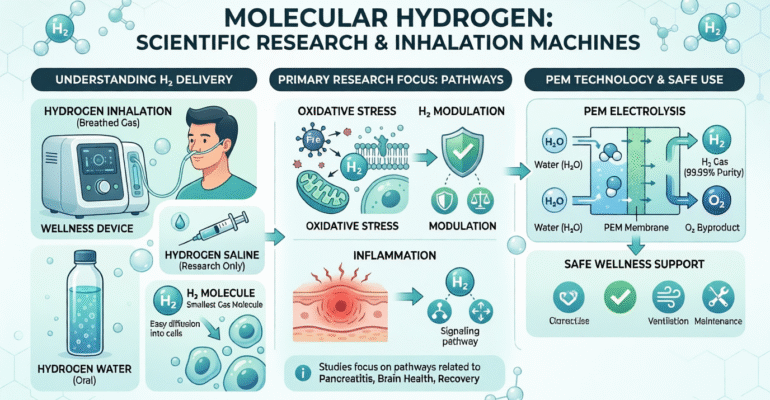
Molecular hydrogen, written as H2, is the smallest gas molecule. Because it is very small, researchers study whether it can diffuse into tissues and influence biological pathways linked with oxidative stress and inflammation. It is not the same as hydrogen peroxide, alkaline water, or ordinary water. In wellness products, hydrogen may be delivered through hydrogen-rich water, hydrogen inhalation, hydrogen-rich saline in research settings, or topical methods.
https://pmc.ncbi.nlm.nih.gov/articles/PMC5731988/
https://molecularhydrogeninstitute.org/is-molecular-hydrogen-safe/
The most important distinction for buyers is route of delivery. Hydrogen-rich water means hydrogen gas is dissolved in water. Hydrogen inhalation means the user breathes a hydrogen-containing gas mixture through a device. Hydrogen-rich saline is usually used in laboratory or clinical research contexts and should not be confused with consumer hydrogen machines. This distinction protects customers from over-reading research findings.
https://pmc.ncbi.nlm.nih.gov/articles/PMC8464006/
https://pmc.ncbi.nlm.nih.gov/articles/PMC8516430/
https://pmc.ncbi.nlm.nih.gov/articles/PMC4508974/
Why Oxidative Stress Is Central to Molecular Hydrogen Research
Oxidative stress happens when reactive oxygen species and other free radicals exceed the body’s antioxidant defense capacity. This does not mean all free radicals are bad. They also have normal signaling roles. Problems arise when imbalance contributes to cellular damage, inflammation, mitochondrial stress, tissue injury, or disease progression. This is why antioxidant research is important, but also why claims must be careful.
https://pubmed.ncbi.nlm.nih.gov/31228811/
https://pmc.ncbi.nlm.nih.gov/articles/PMC10206224/
The antioxidant review you provided discusses natural and synthetic antioxidant molecules and the wider medicinal interest in reducing oxidative stress-related damage. For molecular hydrogen, the key idea is not simply “more antioxidants are always better.” A more accurate explanation is that hydrogen is being studied for possible redox-modulating effects, meaning it may influence oxidative balance and cell signaling without acting like a conventional vitamin antioxidant.
https://pubmed.ncbi.nlm.nih.gov/31228811/
https://molecularhydrogeninstitute.org/is-molecular-hydrogen-safe/
Molecular Hydrogen Research in Pancreatitis
One of the strongest research themes from your sources is pancreatitis. A 2021 review in Life Sciences explains that pancreatitis is an inflammatory disease of the pancreas involving acinar cell injury, abnormal trypsin release, inflammatory response, impaired autophagic flux, endoplasmic reticulum stress, systemic inflammatory response syndrome, and possible multiple organ dysfunction in severe cases.
https://pubmed.ncbi.nlm.nih.gov/33148420/
The same review reports that molecular hydrogen has been studied in pancreatitis because of possible antioxidative stress, anti-inflammatory, anti-apoptosis, immune-regulating, and molecular pathway effects. This is important because pancreatitis is not only a local pancreas problem. Severe inflammatory signaling can affect the wider body, so researchers are interested in interventions that may influence inflammation and cell stress pathways.
https://pubmed.ncbi.nlm.nih.gov/33148420/
However, this review should not be used to claim that a hydrogen inhalation machine treats pancreatitis. It provides a research foundation and possible mechanisms, not a consumer medical guarantee. For customers with pancreatic disease, abdominal pain, digestive symptoms, or a history of acute pancreatitis, hydrogen products should only be considered after medical advice. A hydrogen device is not a substitute for diagnosis, emergency care, medication, surgery, dietary management, or physician-directed treatment.
https://pubmed.ncbi.nlm.nih.gov/33148420/
https://molecularhydrogeninstitute.org/is-molecular-hydrogen-safe/
For Health and Hydrogen readers, the practical takeaway is that pancreatitis research helps explain why molecular hydrogen attracts scientific attention. It points toward oxidative stress, inflammation, autophagy, endoplasmic reticulum stress, and apoptosis as key biological themes. These themes are relevant to education and research, but product pages should remain careful and safety-conscious.
https://healthandhydrogen.com/blogs/
Hydrogen-Rich Water and Alzheimer’s Disease Research
Another major source you provided is the study on hydrogen-rich water and Alzheimer’s disease-related neuropathological impairments. This research used a mouse model of Alzheimer’s disease and reported that hydrogen-rich water was associated with reduced synaptic loss and neuronal death, lower senile plaque burden, reduced hyperphosphorylated tau and neurofibrillary tangles, improved brain energy metabolism problems, changes in intestinal microbiota imbalance, and reduced inflammatory reactions.
https://pubmed.ncbi.nlm.nih.gov/34269217/
https://pmc.ncbi.nlm.nih.gov/articles/PMC8464006/
This study is important for molecular hydrogen research because it connects hydrogen-rich water with brain health pathways, neuroinflammation, energy metabolism, and the gut-brain axis. It also shows why many people ask whether hydrogen water products may support cognitive wellness. But the evidence must be interpreted carefully. A mouse model is not the same as a proven treatment in humans with Alzheimer’s disease.
https://pmc.ncbi.nlm.nih.gov/articles/PMC8464006/
For ecommerce education, this means hydrogen water products can be discussed as part of a wellness and research conversation, not as Alzheimer’s treatment products. Customers interested in hydrogen water can review the Hydro Magic hydrogen water bottle page, but anyone with memory problems, dementia, neurological symptoms, or a family history of neurodegenerative disease should speak with a qualified healthcare professional.
https://healthandhydrogen.com/hah-hm350/
https://healthandhydrogen.com/contact/
Hydrogen-Rich Saline and Early Brain Injury
Your fourth source focuses on hydrogen-rich saline and early brain injury after experimental subarachnoid hemorrhage. The PubMed record describes research on hydrogen-rich saline in relation to endoplasmic reticulum stress and autophagy after experimental subarachnoid hemorrhage. Related full-text summaries report improved neurological outcomes and reduced neuronal death in the experimental model.
https://pubmed.ncbi.nlm.nih.gov/34644772/
https://pmc.ncbi.nlm.nih.gov/articles/PMC8516430/
This matters because it overlaps with the pancreatitis review’s discussion of endoplasmic reticulum stress and autophagy. In simple words, endoplasmic reticulum stress is cell stress related to protein folding and cell survival. Autophagy is a cellular recycling process. Both can be protective or harmful depending on timing and disease context. Hydrogen research often explores whether H2 can help regulate these stress-response pathways.
https://pubmed.ncbi.nlm.nih.gov/33148420/
https://pmc.ncbi.nlm.nih.gov/articles/PMC8516430/
Still, hydrogen-rich saline research should not be translated directly into home use claims. Saline injection in an experimental brain injury model is very different from inhaling hydrogen through a consumer device. The value of the study is mechanistic and scientific. It helps explain why molecular hydrogen research is active in neurological injury, but it does not prove that a home hydrogen machine treats stroke, brain injury, or hemorrhage.
https://pmc.ncbi.nlm.nih.gov/articles/PMC8516430/
https://molecularhydrogeninstitute.org/is-molecular-hydrogen-safe/
Hydrogen-Rich Saline and Peripheral Nerve Recovery
The peripheral nerve study appears to be listed under PMID 26622383, not PMID 2622383. The study investigated hydrogen-rich saline after sciatic nerve autografting in rats and reported better motor functional recovery and nerve regeneration markers compared with normal saline. This makes it relevant to discussions about recovery biology, oxidative stress, nerve repair, and tissue regeneration research.
https://pubmed.ncbi.nlm.nih.gov/26622383/
https://pmc.ncbi.nlm.nih.gov/articles/PMC4508974/
This is an encouraging preclinical result, but it has clear limitations for shoppers. It was not a consumer hydrogen inhalation machine trial. It was not a broad human recovery study. It does not prove that inhaling hydrogen at home repairs nerve damage. The responsible way to use this evidence is to say that molecular hydrogen is being studied in nerve injury models, especially where oxidative stress and inflammation may affect repair.
https://pmc.ncbi.nlm.nih.gov/articles/PMC4508974/
For customers interested in recovery, performance, or wellness routines, this means product choice should be based on safe use, quality, practical fit, and support rather than disease promises. Health and Hydrogen offers different hydrogen inhalation models for different use cases, including HAH 450, HAH 900, HAH 1800, and HAH 3000. Compare the product pages and contact support if you are unsure which machine fits your needs.
https://healthandhydrogen.com/hah-450/
https://healthandhydrogen.com/hah-900/
https://healthandhydrogen.com/hah-1800/
https://healthandhydrogen.com/hah-3000/
https://healthandhydrogen.com/support/
What Do These Studies Mean for Hydrogen Inhalation Machines?
The five sources you provided do not all study inhalation machines. They include molecular hydrogen review research, hydrogen-rich water, hydrogen-rich saline, antioxidant research, and animal models. This is why the best interpretation is pathway-based, not product-claim-based. The shared themes are oxidative stress, inflammation, apoptosis, endoplasmic reticulum stress, autophagy, immune signaling, neuroinflammation, tissue injury, and recovery biology.
https://pubmed.ncbi.nlm.nih.gov/33148420/
https://pubmed.ncbi.nlm.nih.gov/34269217/
https://pubmed.ncbi.nlm.nih.gov/31228811/
https://pubmed.ncbi.nlm.nih.gov/34644772/
https://pubmed.ncbi.nlm.nih.gov/26622383/
For hydrogen inhalation machine buyers, this means research can guide education but should not replace product safety evaluation. A good device conversation should include technology type, gas output, water requirements, accessories, hygiene, session guidance, user manual, warranty, support, and whether the device suits personal use or multiple users. Health and Hydrogen’s FAQ notes that its machines are available in several output levels and that selection depends on intended use, frequency, and whether more than one person may use the machine.
https://healthandhydrogen.com/faqs/
Why PEM/SPE Technology Matters
Health and Hydrogen explains that water electrolysis technology suitable for inhalation includes the polyelectrolyte method, also known as PEM or Proton Exchange Membrane technology, and states that its inhalation devices use PEM technology. For consumers, the practical point is simple: the machine should be designed specifically for hydrogen generation and used according to its manual.
https://healthandhydrogen.com/
The HAH 3000 page lists the product as a hydrogen inhaler model with adjustable flow settings, hydrogen and oxygen output values, 99.99% hydrogen purity, distilled water requirement, and operating conditions. These are product-specific details, so buyers should read the current product page and manual before purchase or use, as specifications may be updated.
https://healthandhydrogen.com/hah-3000/
Is Molecular Hydrogen Safe?
Molecular hydrogen has a low biological toxicity profile when used appropriately, and the Molecular Hydrogen Institute notes that clinical research has not identified known toxic side effects when hydrogen is used as directed. However, safety is not only about the molecule itself. Hydrogen gas is flammable at certain concentrations in air, so device design, ventilation, correct setup, water quality, and avoiding misuse are important.
https://molecularhydrogeninstitute.org/is-molecular-hydrogen-safe/
The same safety discussion notes that hydrogen gas flammability is a practical concern, especially because hydrogen becomes flammable in air over specific concentration ranges. This is why customers should not modify machines, block vents, use non-recommended water, operate damaged equipment, or ignore the user manual. If a user has respiratory disease, cardiovascular disease, neurological disease, cancer, pregnancy, implanted medical devices, or any serious medical condition, medical guidance is recommended before use.
https://molecularhydrogeninstitute.org/is-molecular-hydrogen-safe/
https://healthandhydrogen.com/faqs/
How to Choose a Hydrogen Inhalation Machine
Start with your use case. A lower-output machine may fit personal or occasional use, while higher-output models may be considered for more intensive routines or multiple users. Health and Hydrogen’s FAQ gives this same general direction, noting that output choice depends on intended use, frequency, and whether more than one person will use the machine.
https://healthandhydrogen.com/faqs/
Next, check practical ownership details. Look for product manuals, water requirements, accessories, replacement nasal cannulas, hygiene guidance, warranty information, support access, and video tutorials. Health and Hydrogen provides product pages, accessories, FAQs, support, video session resources, and contact options that help buyers make a more informed decision.
https://healthandhydrogen.com/accessories-for-hydrogen-inhalation-machines/
https://healthandhydrogen.com/video-session/
https://healthandhydrogen.com/support/
https://healthandhydrogen.com/contact/
Frequently Asked Questions
1. What is the main focus of molecular hydrogen research?
The main focus is how molecular hydrogen may influence oxidative stress, inflammation, cell signaling, apoptosis, autophagy, energy metabolism, and tissue injury pathways. Current evidence is promising but varies by condition, route of delivery, and study type.
https://pubmed.ncbi.nlm.nih.gov/33148420/
2. Does molecular hydrogen cure pancreatitis?
No. The pancreatitis review discusses possible mechanisms and research progress, but it does not prove that hydrogen products cure pancreatitis. Pancreatitis requires proper medical diagnosis and treatment.
https://pubmed.ncbi.nlm.nih.gov/33148420/
3. Does hydrogen-rich water treat Alzheimer’s disease?
No consumer product should be marketed as an Alzheimer’s treatment based on the current evidence. The study you provided was in a mouse model and is useful for research discussion, not for making human treatment claims.
https://pubmed.ncbi.nlm.nih.gov/34269217/
4. Is hydrogen-rich saline the same as hydrogen inhalation?
No. Hydrogen-rich saline is a research preparation usually administered in experimental or clinical settings. Hydrogen inhalation uses a device to deliver hydrogen-containing gas. Results from saline studies should not be directly treated as inhalation proof.
https://pmc.ncbi.nlm.nih.gov/articles/PMC8516430/
5. Is a hydrogen inhalation machine safe for daily wellness use?
Hydrogen itself has a low toxicity profile when used as directed, but safe use depends on the device, ventilation, instructions, water quality, and user health status. Follow the manual and speak with a healthcare professional if you have medical conditions.
https://molecularhydrogeninstitute.org/is-molecular-hydrogen-safe/
6. Which Health and Hydrogen machine should I choose?
Choose based on intended use, frequency, and whether one or multiple people will use it. Health and Hydrogen offers several output levels, and customers can compare product pages or contact support for product-specific questions.
https://healthandhydrogen.com/faqs/
https://healthandhydrogen.com/shop
7. What is PEM technology in hydrogen machines?
PEM means Proton Exchange Membrane. Health and Hydrogen states that its inhalation devices use PEM technology, a water electrolysis approach used to generate hydrogen for inhalation devices.
https://healthandhydrogen.com/
8. Can I use a hydrogen machine instead of medication?
No. Hydrogen products should not replace prescribed medication, emergency care, surgery, rehabilitation, or medical advice. They should be considered wellness or research-informed products unless a qualified healthcare professional advises otherwise.
https://molecularhydrogeninstitute.org/is-molecular-hydrogen-safe/
9. Are hydrogen water products and inhalation machines used for the same purpose?
They both deliver molecular hydrogen, but through different routes. Hydrogen water is consumed orally, while inhalation delivers hydrogen-containing gas through breathing. Research findings should be interpreted according to the specific delivery method studied.
https://pmc.ncbi.nlm.nih.gov/articles/PMC8464006/
10. Where can I get help choosing accessories or learning correct use?
You can review Health and Hydrogen’s accessories page, FAQs, video session page, support page, and contact page for product guidance and help.
https://healthandhydrogen.com/accessories-for-hydrogen-inhalation-machines/
https://healthandhydrogen.com/video-session/
https://healthandhydrogen.com/support/
https://healthandhydrogen.com/contact/
Conclusion
Molecular hydrogen research is strongest when explained carefully. The studies you provided point toward important biological pathways, especially oxidative stress, inflammation, neuroinflammation, apoptosis, autophagy, endoplasmic reticulum stress, tissue injury, and recovery biology. The pancreatitis review is especially relevant because it connects hydrogen with several mechanisms that researchers are actively studying. The Alzheimer’s mouse model, early brain injury study, and peripheral nerve autograft study add further support for scientific interest, but they do not justify exaggerated consumer medical claims.
https://pubmed.ncbi.nlm.nih.gov/33148420/
https://pubmed.ncbi.nlm.nih.gov/34269217/
https://pubmed.ncbi.nlm.nih.gov/34644772/
https://pubmed.ncbi.nlm.nih.gov/26622383/
For buyers, the best approach is evidence-aware and safety-first. Choose a hydrogen inhalation machine or hydrogen water product based on real needs, device quality, clear instructions, support, accessories, and responsible expectations. Molecular hydrogen research can help you understand why the field is growing, but safe product use and professional medical guidance remain essential.
To compare Health and Hydrogen devices, visit the shop, review the HAH product pages, read the FAQs, and contact support for product-specific guidance before choosing your machine.
https://healthandhydrogen.com/shop
https://healthandhydrogen.com/faqs/
https://healthandhydrogen.com/support/
Search
Categories
- ANI NEWS (1)
- AP NEWS (1)
- Applications (26)
- Beauty Clinics (1)
- BENZINGA ESPANA (1)
- BOLSAMANIA (1)
- Brain cancer (14,615)
- Breast Cancer (12,744)
- Cervical Cancer (11,502)
- Cision (1)
- Colon Cancer (11,405)
- EUROPA PRESS (1)
- FINANZEN (1)
- Genetic and Congenital Disorders (195)
- Hydrogen Inhalation Machine (15,420)
- Hydrogen Inhalation Therapy (11,414)
- Infectious Diseases (242)
- Lung Cancer (11,505)
- News (8)
- Non Alcoholic Fatty Liver (11,504)
- Ovarian Cancer (11,506)
- Oxidative Stress (2)
- Pancreatic cancer (11,505)
- Parkinson's disease (10,167)
- Post Covid (11,504)
- PR Newswire (1)
- Press Release (13)
- Seeking Alpha (1)
- The Print (1)
- The Times of India (1)
- Uncategorized (9)
- WALLSTREET ONLINE (1)
- ZEE 5 (1)