Molecular Hydrogen Therapy: What Studies Say About Hydrogen Inhalation, Hydrogen Water, and Safety
May 14, 2026 2026-05-14 4:52Molecular Hydrogen Therapy: What Studies Say About Hydrogen Inhalation, Hydrogen Water, and Safety
Molecular Hydrogen Therapy: What Studies Say About Hydrogen Inhalation, Hydrogen Water, and Safety
Written by clinical researcher, Dr. Aamir Sohail, PhD in biochemistry and molecular biology: aamir.sohail@oncofit.in.
People interested in a hydrogen inhalation machine usually ask one serious question first: is molecular hydrogen therapy supported by real science, or is it only a wellness trend? The honest answer is that molecular hydrogen is an active research area with promising early evidence, especially around oxidative stress and inflammation, but it should not be presented as a proven cure, treatment, or replacement for medical care. This guide explains what the supplied studies show, what they do not prove, and how to think about hydrogen inhalation devices and hydrogen water products safely.
Table of Contents
ToggleQuick Answer
Molecular hydrogen therapy means using hydrogen gas or hydrogen-rich water as a wellness or research-supported intervention. Studies suggest molecular hydrogen may influence oxidative stress, inflammation, stress-response markers, and antioxidant balance, but clinical evidence is still developing and should not be interpreted as proof that hydrogen inhalation or hydrogen water treats, cures, or prevents disease. Buyers should focus on safety, device quality, PEM or SPE technology, proper water use, manuals, and professional medical advice when needed.
https://www.biomed.cas.cz/physiolres/pdf/65/65_S11.pdf
https://www.sciencedirect.com/science/article/pii/S0006291X20322129
https://www.researchgate.net/publication/375988541_Molecular_Hydrogen_Therapy-A_Review_on_Clinical_Studies_and_Outcomes
Key Takeaways
- Molecular hydrogen is being studied because it may selectively interact with highly reactive radicals such as hydroxyl radicals and peroxynitrite.
- Research links hydrogen biology mainly to oxidative stress, inflammation, antioxidant balance, and cell-signaling pathways.
- Human research exists, but many findings are early, condition-specific, or not strong enough for disease-treatment claims.
- Hydrogen inhalation and hydrogen water are different delivery methods, so buyers should not compare them only by price.
- Safety depends on device design, gas concentration, oxygen balance, ventilation, water quality, accessories, and user instructions.
- Health and Hydrogen provides hydrogen inhalation machines, hydrogen water products, accessories, FAQs, support, and video sessions for product-specific guidance.
- Anyone with a medical condition, pregnancy, implanted devices, respiratory disease, or active treatment plan should speak with a qualified healthcare professional before use.
What Is Molecular Hydrogen Therapy?
Molecular hydrogen therapy refers to the use of H2, either inhaled as gas, dissolved in water, used in hydrogen-rich saline in clinical settings, or added to specific medical systems such as dialysis. The research interest increased after studies proposed that H2 may act differently from many general antioxidants because it is small, neutral, and able to diffuse through tissues. Review literature describes hydrogen as a molecule being explored for antioxidant, anti-inflammatory, anti-apoptotic, and signaling-related effects, while also noting that exact mechanisms and optimal dosing still require further study.
https://www.biomed.cas.cz/physiolres/pdf/65/65_S11.pdf
https://www.sciencedirect.com/science/article/pii/S0163725814000941
For ecommerce buyers, this matters because “hydrogen therapy” is often used loosely online. A responsible wellness brand should explain that hydrogen inhalation machines and hydrogen water devices are not magic medical treatments. They are wellness tools connected to an expanding scientific field. The best buying decision is based on research literacy, safety, device technology, support, warranty, and realistic expectations.
Why Are Researchers Interested in Hydrogen and Oxidative Stress?
Oxidative stress happens when reactive oxygen and nitrogen species become excessive compared with the body’s antioxidant defenses. The 2016 review supplied in your source list explains that hydroxyl and nitrosyl radicals can damage biomolecules and that molecular hydrogen reacts with strong oxidants such as hydroxyl radicals and nitrosyl radicals. The same review also states that H2 diffuses rapidly into tissues and cells, and may reduce oxidative stress through gene-expression regulation and anti-inflammatory or anti-apoptotic pathways.
https://pubmed.ncbi.nlm.nih.gov/27643933/
https://www.biomed.cas.cz/physiolres/pdf/65/65_S11.pdf
This is important because many people assume “antioxidant” means the same thing for every supplement or device. Molecular hydrogen research is more specific. The proposed value is not that H2 blocks every oxidative reaction. In fact, normal reactive oxygen species are also involved in useful biological signaling. The scientific interest is that H2 may be mild and selective enough to interact with highly damaging radicals without broadly disturbing normal redox signaling, although this remains an active area of research.
https://pubmed.ncbi.nlm.nih.gov/24769081/
https://pubmed.ncbi.nlm.nih.gov/17486089/
What Did the Hydrogen Haemodialysis Clinical Trial Show?
One of the most relevant human studies in your source list is the 2010 clinical trial on haemodialysis using dissolved H2 produced by water electrolysis. In this study, researchers developed a dialysis solution containing dissolved hydrogen and observed 21 stable patients on standard haemodialysis who were switched to the test system for 6 months, three sessions per week. The study reported no adverse clinical signs or symptoms during the study period, minimal changes in dialysis parameters, decreased inflammatory markers, and improved blood pressure control.
https://pubmed.ncbi.nlm.nih.gov/20388631/
https://doi.org/10.1093/ndt/gfq196
For Health and Hydrogen readers, the main lesson is not that a home hydrogen inhalation machine can copy a dialysis intervention. That would be an unsupported claim. The useful takeaway is that electrolysis-generated hydrogen has been studied in a serious clinical context, especially where oxidative stress and inflammation are biologically relevant. It also shows why device quality, water quality, and controlled delivery matter when discussing hydrogen technologies.
What Did the Electrolyzed Hydrogen Water Stress Study Show?
The 2021 study on electrolyzed hydrogen water examined rats exposed to 5 days of continuous stress challenge. The researchers reported that stress increased reactive oxygen metabolite-derived compounds, IL-1β, and ACTH, while decreasing biological antioxidant potential. Drinking electrolyzed hydrogen water during the stress challenge significantly alleviated those changes. The authors concluded that electrolyzed hydrogen water could suppress stress-response-associated oxidative stress and IL-1β elevation in vivo through antioxidant potential.
https://pubmed.ncbi.nlm.nih.gov/33340760/
https://www.sciencedirect.com/science/article/pii/S0006291X20322129
This is useful for wellness content, but it must be interpreted carefully. The study was performed in animals, not as a human clinical proof for anxiety, burnout, depression, chronic fatigue, or any medical diagnosis. A careful ecommerce blog can say that electrolyzed hydrogen water is being studied for stress-related oxidative and inflammatory pathways. It should not say that hydrogen water treats stress disorders or replaces sleep, nutrition, therapy, medication, or medical advice.
What Do Review Articles Say About Preventive Hydrogen Research?
The review “Preventive and therapeutic application of molecular hydrogen in situations with excessive production of free radicals” argues that hydrogen deserves attention in contexts where excessive free radical production is involved. However, it also notes that exact mechanisms, dose-response effects, and concentration efficiency in different disease models still require more exploration. This balance is central to trustworthy hydrogen education.
https://pubmed.ncbi.nlm.nih.gov/27643933/
https://www.biomed.cas.cz/physiolres/pdf/65/65_S11.pdf
Another review, “Molecular Hydrogen as a Preventive and Therapeutic Medical Gas,” describes several possible administration methods, including inhaling hydrogen gas and drinking hydrogen-dissolved water. It also states that H2 may reduce oxidative stress directly through reactions with strong oxidants and indirectly through gene-expression regulation. This supports the idea that hydrogen research is not limited to one device type, but it does not prove that every consumer product has the same effect.
https://pubmed.ncbi.nlm.nih.gov/24769081/
https://www.sciencedirect.com/science/article/pii/S0163725814000941
What Does “Pre-Symptomatic Disease” Mean in Hydrogen Research?
The 2021 review on molecular hydrogen as a protective agent against pre-symptomatic diseases uses the term “mibyou,” meaning a state where disease processes may be developing before obvious symptoms appear. The review discusses chronic inflammation, oxidative stress, hydroxyl radicals, and pathways such as NLRP3 inflammasome activation. It proposes hydrogen as a possible protective agent in this early biological context, but this is a review-based hypothesis area rather than a consumer disease-prevention claim.
https://pubmed.ncbi.nlm.nih.gov/34281264/
https://pmc.ncbi.nlm.nih.gov/articles/PMC8268741/
https://www.mdpi.com/1422-0067/22/13/7211
For website content, this topic is powerful for AEO and GEO because users ask AI tools direct questions such as “Can hydrogen help before disease starts?” A responsible answer is: hydrogen is being studied for biological processes linked with oxidative stress and chronic inflammation, but consumers should not use hydrogen devices as disease-prevention tools without medical supervision.
Hydrogen Inhalation Machine vs Hydrogen Water: What Is the Difference?
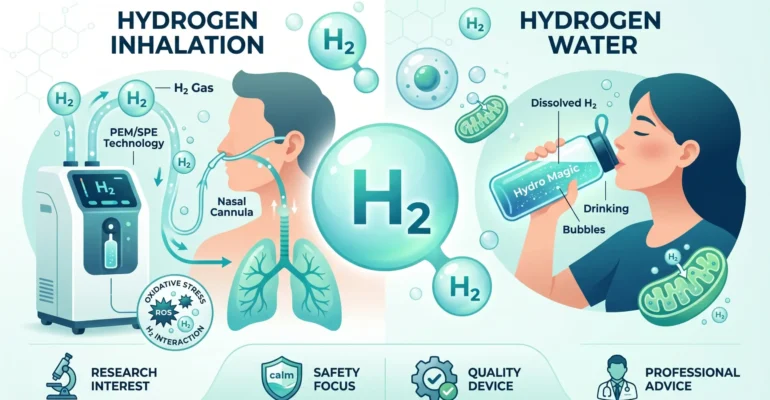
Hydrogen inhalation delivers H2 through breathing, while hydrogen water delivers dissolved H2 through drinking. The Molecular Hydrogen Institute notes that inhalation and drinking are common methods, but pharmacokinetics depend on route, dose, and timing. It also states that a 2 to 4 percent hydrogen gas mixture is common in some inhalation research because it is below flammability level, while hydrogen-rich water has low solubility and a shorter half-life than many other dissolved gases.
https://molecularhydrogeninstitute.org/hydrogen-an-emerging-medical-gas/
For buyers, this means a hydrogen inhalation machine and a hydrogen water bottle should not be treated as identical. Inhalation may be chosen by people seeking direct gas delivery through a device, while hydrogen water may suit people who prefer a daily hydration-based format. Health and Hydrogen offers hydrogen inhalation machine pages and a Hydro Magic hydrogen water bottle page, so users can compare format, budget, support needs, and lifestyle use without making disease claims.
https://healthandhydrogen.com/hah-3000/
https://healthandhydrogen.com/hah-hm350/
Why PEM and SPE Technology Matter
Health and Hydrogen states on its homepage that its inhalation devices use PEM technology, also known as Proton Exchange Membrane technology, and describes PEM as a water electrolysis method relevant for hydrogen inhalation. Product pages also list SPE and PEM technology on models such as HAH 1800, HAH 900, and HAH 450.
https://healthandhydrogen.com/
https://healthandhydrogen.com/hah-1800/
https://healthandhydrogen.com/hah-900/
https://healthandhydrogen.com/hah-450/
In simple language, PEM or SPE systems are used to help separate gases during electrolysis and support cleaner hydrogen production compared with basic uncontrolled electrolysis systems. Buyers should still read the exact product manual, use the required water type, maintain the device, replace accessories as instructed, and contact support if they are unsure about setup or operation.
How to Choose a Hydrogen Inhalation Machine
The right hydrogen inhalation machine depends on intended use, frequency, number of users, budget, support needs, and product specifications. Health and Hydrogen’s FAQ page says lower-output models such as 450 ml or 900 ml may suit personal or less frequent use, while higher-output models such as 1.8 liters or 3 liters may be considered for more intensive or multiple-user scenarios.
https://healthandhydrogen.com/faqs/
Health and Hydrogen lists several product options, including HAH 3000, HAH 1800, HAH 900, HAH 450, and Hydro Magic. For example, the HAH 3000 page lists adjustable total flow settings of 3000, 2000, and 1000 ml/min and a hydrogen purity value of 99.99 percent. The HAH 900 page lists H2 output of 600 ml/min and O2 output of 300 ml/min, while the HAH 450 page lists H2 output of 300 ml/min and O2 output of 150 ml/min. These are product specifications, not medical outcome claims.
https://healthandhydrogen.com/hah-3000/
https://healthandhydrogen.com/hah-900/
https://healthandhydrogen.com/hah-450/
Safety: What Buyers Should Know Before Using Hydrogen Devices
Hydrogen gas is not toxic in the way many chemicals are toxic, but safety still matters because hydrogen is flammable within certain concentrations in air. The Molecular Hydrogen Institute states that hydrogen gas is highly flammable between 4 percent and 75 percent by volume, and that device safety depends on concentration, oxygen, contaminants, and method of use.
https://molecularhydrogeninstitute.org/is-molecular-hydrogen-safe/
Practical safety guidance is simple: use the product only as directed, keep the device in a suitable ventilated area, avoid flames or sparks, use the recommended water type, do not modify the tubing or accessories, do not block vents, do not share cannulas without hygiene precautions, and stop using the machine if you notice damage, abnormal noise, leaks, overheating, or unexpected symptoms. People with medical conditions should consult a qualified healthcare professional before use.
Health and Hydrogen also provides support resources, including ordering help, product information, troubleshooting, operation and maintenance links, instruction manuals, safety pages, and research support. These pages are important internal links because they help users move from education to safe use.
https://healthandhydrogen.com/support/
https://healthandhydrogen.com/video-session/
https://healthandhydrogen.com/contact/
FAQs About Molecular Hydrogen Therapy
1. What is molecular hydrogen therapy?
Molecular hydrogen therapy is the use of H2 gas or hydrogen-rich water in research and wellness contexts. It is being studied for oxidative stress, inflammation, and cell-signaling effects, but it should not be described as a proven cure or treatment.
2. Is hydrogen inhalation the same as drinking hydrogen water?
No. Hydrogen inhalation uses breathed gas from a device, while hydrogen water contains dissolved H2 for drinking. They differ in delivery route, timing, convenience, and device requirements.
3. Does molecular hydrogen cure disease?
No consumer hydrogen product should claim to cure, treat, diagnose, or prevent disease unless properly approved for that purpose. The research is promising, but buyers should keep expectations realistic.
4. What did the haemodialysis hydrogen study show?
The 2010 trial studied dissolved H2 in dialysis solution for 21 stable haemodialysis patients over 6 months. It reported no adverse clinical signs during the study and changes in inflammatory markers and blood pressure control, but this does not prove home-device disease treatment.
https://pubmed.ncbi.nlm.nih.gov/20388631/
5. What did the chronic stress hydrogen water study show?
In a rat model, electrolyzed hydrogen water reduced stress-related changes in oxidative stress, IL-1β, ACTH, and antioxidant potential. This supports further research, but it is not proof that hydrogen water treats human stress disorders.
https://pubmed.ncbi.nlm.nih.gov/33340760/
6. Is molecular hydrogen safe?
Hydrogen itself has a strong safety profile in many research contexts, but hydrogen gas is flammable at certain air concentrations. Device safety depends on proper design, correct use, ventilation, water quality, and following the manual.
https://molecularhydrogeninstitute.org/is-molecular-hydrogen-safe/
7. What should I look for in a hydrogen inhalation machine?
Look for reliable electrolysis technology, clear product specifications, manuals, correct water-quality instructions, accessories, warranty or support information, and transparent claims that avoid exaggerated medical promises.
8. Can multiple people use one hydrogen machine?
Health and Hydrogen’s FAQ says some machines can be used by multiple people, especially higher-output models, but each user should have their own nasal cannula or breathing apparatus for hygiene.
https://healthandhydrogen.com/faqs/
9. How long should a beginner use a hydrogen inhalation machine?
Health and Hydrogen’s FAQ mentions that a common starting point may be 30 minutes to 1 hour daily, while also recommending healthcare professional guidance for individual needs.
https://healthandhydrogen.com/faqs/
10. Where can I get help choosing a Health and Hydrogen product?
You can review the product pages, FAQs, support page, accessories page, and video session page, or contact Health and Hydrogen for product-specific questions.
https://healthandhydrogen.com/support/
https://healthandhydrogen.com/contact/
Conclusion
Molecular hydrogen therapy is one of the more interesting wellness and medical-gas research areas because it connects to oxidative stress, inflammation, antioxidant balance, and hydrogen delivery technology. The supplied PubMed studies and reviews show real scientific interest in dissolved hydrogen, electrolyzed hydrogen water, free radical biology, pre-symptomatic inflammation, and hydrogen as a medical gas. However, the best interpretation is careful: the research is promising, but not a license to make disease-treatment claims.
For buyers, the practical decision is about choosing a safe, well-supported hydrogen inhalation machine or hydrogen water product, understanding the difference between inhalation and drinking, following the manual, using correct water and accessories, and speaking with a healthcare professional when medical conditions are involved. Health and Hydrogen can support that journey with PEM and SPE hydrogen devices, hydrogen water products, accessories, FAQs, support resources, regulatory education, and product guidance.
Soft CTA
Explore Health and Hydrogen’s product range, compare hydrogen inhalation machines, review the FAQs, and contact support if you need help choosing the right device for your wellness routine.
https://healthandhydrogen.com/
https://healthandhydrogen.com/shop
https://healthandhydrogen.com/faqs/
https://healthandhydrogen.com/support/
Search
Categories
- ANI NEWS (1)
- AP NEWS (1)
- Applications (26)
- Beauty Clinics (1)
- BENZINGA ESPANA (1)
- BOLSAMANIA (1)
- Brain cancer (14,615)
- Breast Cancer (12,744)
- Cervical Cancer (11,502)
- Cision (1)
- Colon Cancer (11,405)
- EUROPA PRESS (1)
- FINANZEN (1)
- Genetic and Congenital Disorders (195)
- Hydrogen Inhalation Machine (15,420)
- Hydrogen Inhalation Therapy (11,414)
- Infectious Diseases (242)
- Lung Cancer (11,505)
- News (8)
- Non Alcoholic Fatty Liver (11,504)
- Ovarian Cancer (11,506)
- Oxidative Stress (2)
- Pancreatic cancer (11,505)
- Parkinson's disease (10,167)
- Post Covid (11,504)
- PR Newswire (1)
- Press Release (13)
- Seeking Alpha (1)
- The Print (1)
- The Times of India (1)
- Uncategorized (9)
- WALLSTREET ONLINE (1)
- ZEE 5 (1)